The Bank continuously endeavours to understand the concerns and opinions expressed by stakeholders and appropriately respond to them. The Bank holds regular interactions with customers, investors, employees, regulators and engages with communities and relevant industry bodies to remain informed.
Engagement with employees is through various platforms including townhall sessions with directors, periodic communication meetings and business centre visits by senior leaders, videos to communicate with employees through the employee app Universe on the Move, and query raising portal.
Subjects considered important by our employees:
The Bank believes in giving responsibility to young capable employees and support them early in their professional journey. Learning and skill development are important value propositions provided to employees. The focus of skill development initiatives is on functional and behavioural learning including trends in IT, data privacy, fraud management. Principles of diversity, equity and inclusion are embedded in HR practices at the Bank. Promoting job rotation and encouraging employees to move across roles is helping the Bank in providing career growth to employees. The fair compensation policy aligns rewards with prudent risk taking. For care and well-being of employees, relevant policies and practices have been established. The Bank has a culture where employees can raise issues freely, also enabled online through ‘I-Care’, and can expect their grievances / concerns to be handled in a sensitive manner.
The Bank’s philosophy of CSR is rooted in the strategic objectives of scalability and sustainability. Empowering communities, supporting environment conservation and restoration, and helping mainstream the marginalised segments aligns with the Bank’s core purpose of promoting sustainable development. In fiscal 2025, the Bank focussed on partnering with established institutions delivering health and education to socially underprivileged sections of the society. The approach to undertaking CSR activities also aimed at positive impact on ecosystems by designing comprehensive and integrated interventions. The key thematic areas in which CSR initiatives were pursued were healthcare, environment and ecology, livelihood and community development.
In fiscal 2025, the Bank fulfilled its obligation of ₹8.01 billion towards CSR, most of which was through the Group’s philanthropic arm, the ICICI Foundation for Inclusive Growth (ICICI Foundation). In healthcare, the focus was on supporting hospitals and medical institutions for providing credible healthcare services in the areas of cancer care, cardiac care and eye care. These initiatives were driven through collaboration with 50 hospitals during the year, and impacted 0.4 million people in terms of receiving affordable healthcare. The Bank’s flagship initiative in healthcare is the setting up of three greenfield cancer care facilities, one each in Andhra Pradesh, Maharashtra and Punjab, in collaboration with Tata Memorial Centre. The foundation stone for the hospital at Visakhapatnam, Andhra Pradesh, was laid in June 2025.
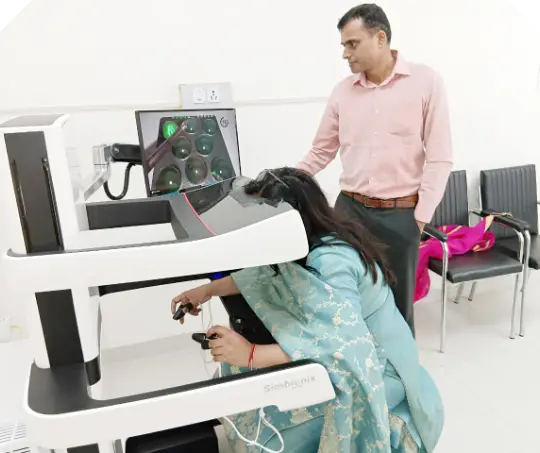
A medical professional undergoing training on a robotic surgical simulator provided by ICICI Foundation to Baba Farid University of Health Sciences in Faridkot, Punjab.
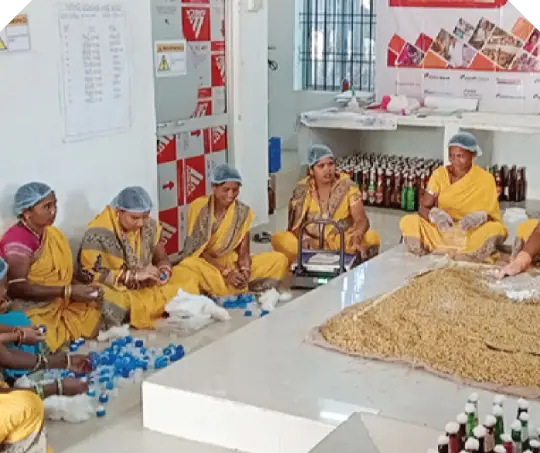
Women from Adishakti SHG involved in mushroom spawn production at an unit supported by ICICI Foundation in Khurigaon village, Kashipur block, Rayagada district, Odisha.
In environment and ecology, the principle areas of work included water conservation, plantation, enabling supply of renewable energy to rural schools and households, and waste management. Till March 31, 2025, cumulative water harvesting potential of about 33.87 billion litres had been created and 4.9 million saplings had been planted. Activities were also undertaken across 56 forest reserves in collaboration with the forest authorities, to undertake initiatives on habitat restoration, rejuvenation of water sources, creating water ponds and setting up renewable energy capacity.


The Manaura Ahar (a traditional water harvesting system) revived through the water conservation initiatives of ICICI Foundation at Samaspur village in Gaya district, Bihar.
ICICI Foundation also undertook initiatives in the areas of agricultural and allied activities and skill development with a focus on improving livelihoods. These efforts led to creation of rural entrepreneurs and impacted 5.2 million lives in fiscal 2025. Community development programmes included local need-based projects, supporting disaster relief and rehabilitation, and promoting financial literacy.
There are specific segments of the rural economy that require a more supportive and sensitive response to their financial requirements and the Bank has taken initiatives to address the needs of such segments. The Self-Help Groups (SHGs) programme is an initiative that has been contributing to entrepreneurship development among women. A comprehensive suite of banking products, including zero-balance savings account, working capital and term loans, for meeting the business requirements of the women of these SHGs is provided. Services are offered at their doorstep and through the closest business centre, thus saving their time, money and labour.
ICICI Bank has been extending loans/providing financial support to less privileged women through the Self Help Groups - Bank Linkage Programme (SHGs-BLP) for over a decade, to give a boost to their entrepreneurial spirit. These initiatives have positively impacted 11 million women across the country through approximately 9.8 lakh SHG loans on a cumulative basis as on March 31, 2025. Of these, 4.96 lakh were first-time borrowers, who had not taken a loan earlier from any formal financial institution. These SHGs are engaged in livelihood-generating activities which are helping them scale up their economic enterprises and improve financial security.
In addition to direct customers, the Bank reached out to about 2.2 million customers through microfinance institutions. The Bank also provides lending to Joint Liability Groups (JLGs), which are semi-formal groups from the weaker sections of society, through microfinance companies. These activities are undertaken within the overall framework prescribed by the RBI. The Bank also offers credit-related services to microfinance companies for onward lending to the rural population.
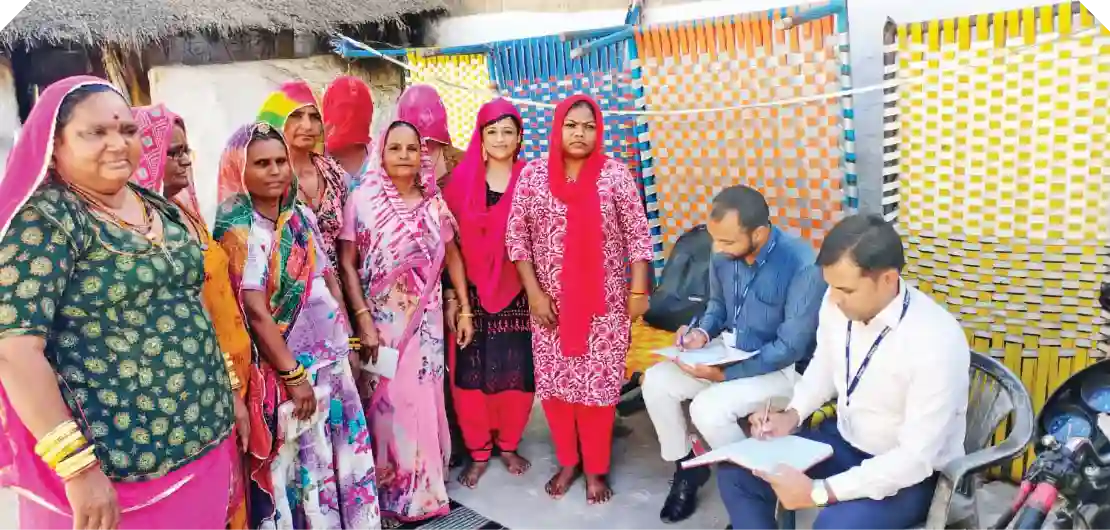
Members of an SHG in Nagaur district, Rajasthan, being informed about the various loans that they can avail through ICICI Bank.
At March 31, 2025, the Bank had 4.9 million accounts opened under the Pradhan Mantri Jan Dhan Yojana. These are zero charges accounts. The Bank encourages and enables these account holders to transact digitally.
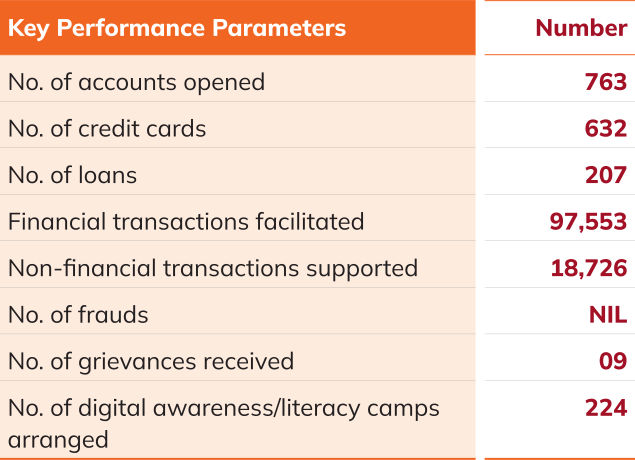
Technology has been a key enabler for the Bank in fostering financial inclusion. The delivery of financial services in remote unbanked and under-banked areas has been made possible due to digitisation. In fiscal 2023, the Government of India announced the launch of Digital Banking Units (DBUs) with the objective of encouraging customers to undertake and experience the benefits of digital transactions. The DBUs are primarily fixed-point business units for delivering digital banking products and services, with most services made available in both self-service and assisted mode. The Bank set up four such DBUs as part of the initiative. Key performance parameters of the DBUs during fiscal 2025 were as follows: