


Chapter 1.3Lending landscape: Microlending in India’s expanding retail lending space
India’s lending ecosystem has been transformed by digital innovation, progressive regulation and the availability of trusted data sources. Equally significant is the cultural shift in attitudes toward borrowing. Once viewed as a last resort—limited to emergencies or venturing into setting up large businesses — borrowing is now widely accepted as a means to achieve personal and professional goals. Small businesses that once depended solely on personal savings to start and operate are increasingly turning to formal credit to meet their working capital needs.

Microfinance Industry AUM & Growth Rate
Inclusive Growth Through Resilient Microfinance Nanaiah Kalengada
1.3 Lending landscape: Microlending in India’s expanding retail lending space
India’s lending ecosystem has been transformed by digital innovation, progressive regulation and the availability of trusted data sources. Equally significant is the cultural shift in attitudes toward borrowing. Once viewed as a last resort—limited to emergencies or venturing into setting up large businesses — borrowing is now widely accepted as a means to achieve personal and professional goals. Small businesses that once depended solely on personal savings to start and operate are increasingly turning to formal credit to meet their working capital needs.
This cultural shift is evident in everyday decisions—for instance, a prospective car buyer today more often focuses on the capacity to make an initial down payment and monthly EMI, rather than the total cost of the vehicle to make the final decision. This evolving mindset, coupled with India’s demographic dividend and large aspirational middle class, is fueling strong and sustained demand for credit across the country. Banks, NBFCs, and the expanding fintech ecosystem are actively tapping into this opportunity, accelerating the formalization and penetration of credit.
Initially, the financial inclusion movement was led by microfinance institutions and self-help group initiatives, which focused on extending credit access to underserved populations in rural and semi-urban India. This bottom- up approach laid the foundation for India’s financial inclusion journey—starting in rural areas, gradually expanding to semi-urban, and, to a limited extent, urban regions.
Today, FinTech’s are contributing significantly to this journey as well, but from the opposite direction, beginning in urban centers and progressively expanding into semi-urban and rural markets. They are helping bring access to credit to underserved customer segments, including Gen Z and individuals with little to no formal credit history. By leveraging both traditional credit bureau data and alternative data sources—such as digital footprints, transaction patterns, and mobile usage— fintechs are reaching borrowers previously either excluded or deterred by the complexity of the formal lending ecosystem.
This convergence of traditional and new-age financial players is shaping a promising finan- cial inclusion story in India. Yet, much remains to be done. Expanding access to the “new-to- credit” segment will require broader adoption of frameworks like Account Aggregators (AA) and greater use of alternative data, including UPI and consumption behaviour, to build more inclusive and accurate credit assessments.
Retail credit in India has grown significantly over the last few years, and most importantly, the unsecured credit growth has been phenomenal. However, signs of moderation are emerging, according to the TransUnion CIBIL Credit Market Indicator (CMI) Report — June 2025. The report reveals important shifts in credit demand across urban, semi- urban, and rural regions, highlighting evolving consumption patterns and financial behaviour. In particular, rural India accounted for 22% of total credit enquiries in March’25, up from 20% in both March 2023 and March 2024. Semi-urban regions led the trend, with their share rising to 30% in March’25, compared to 29% in March’24 and 28% in March’23. Urban accounted for 19% of the credit enquiries as on March’25 compared to 20% in March’23 & March’24. Meanwhile, metro areas saw a decline, with their share of enquiries dropping from 32% in March ‘23 to 29% in March ‘25.
While it may be premature to call this a structural rural shift, these numbers signal a growing appetite for credit outside urban & metro centers. This aligns with themes discussed earlier, government interventions in rural infrastructure and financial inclusion initiatives, cultural shifts toward formal borrowing, and the availability of alternative and trusted data sources, all contributing to deeper credit penetration in the country and more specifically in non-urban areas.
While much of the discussion has focused on the surge in retail unsecured lending in India, microlending has grown in parallel, demonstrating its increasing importance in India’s credit landscape.
Pradhan Mantri Mudra Yojana (PMMY) launched in 2015, was designed to provide access to credit to non-corporate, non-formal micro and small enterprises across the country. Since its inception, the program has sanctioned over 52 crore loans amounting to approximately ₹32.6 lakh crore (as per PIB report,7th April’25), with women accounting for the majority of beneficiaries (68%). Most of these loans have been small-ticket ‘Shishu’ loans, fostering first-time entrepreneurship and supporting self-employment among underserved populations. MUDRA has laid the foundation for grassroots entrepreneurship in India.
Lakhpati Didi initiative launched in 2023 under the Deendayal Antyodaya Yojana—National Rural Livelihood Mission (DAY-NRLM), it focuses on empowering SHG members to transition into entrepreneurial ventures. By leveraging their inherent skills and potential, the program positions them to move into higher income brackets. This initiative has rapidly advanced financial empowerment for rural women across India. As of the PIB report dt 29th Aug’24, over one crore women have achieved ‘Lakhpati Didi’ status, meaning their annual income exceeds ₹1 lakh. The scheme is being implemented across 7,000 blocks in 742 districts.
Fintech’s in India played a significant role in personal loan growth, starting the journey around 2018. During FY24–25, as highlighted in the FACE Report (Apr 2018 – Mar 2025), of the 14 crore personal loan accounts sanctioned amounting to ₹8.8 lakh crore during the year, Fin- Tech NBFCs contributed 10.9 crore loans worth ₹1,06,548 crore. While their share was only 12% of the total sanction val- ue, fintech’s drove 74% of sanction volumes, under- scoring their impact on expanding access to credit. Importantly, 56% of the total loan value comprised tickets below ₹50,000, meeting the demand for small-ticket loans often overlooked by traditional banks. Borrower demographics further highlight in- clusivity: over two-thirds of sanction value went to borrowers under 35 years of age, and 16% was disbursed to women, reflecting both youth adoption and increasing female partici- pation. Together, these trends firmly establish fintech’s as key enablers of digital financial in- clusion in India.
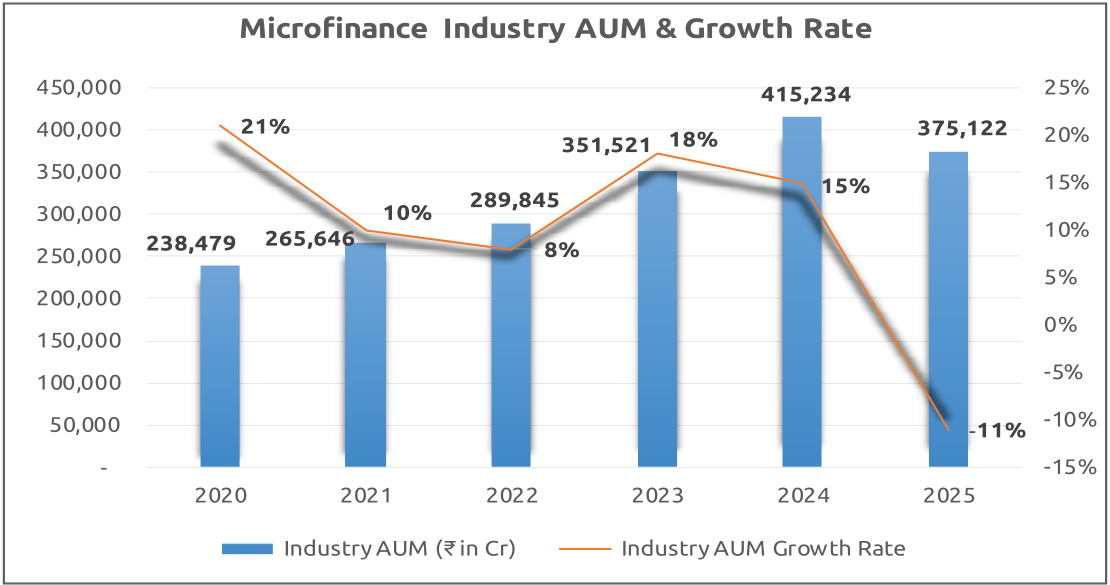
Microfinance portfolio more than doubled from ₹1.87 lakh crore in 2019 to a peak of ₹4.15 lakh crore in 2024, before moderating slightly to ₹3.75 lakh crore as of March’25. In comparison, the personal loan portfolio stood at ₹14.81 lakh crore as on March ‘25, positioning microfinance at approximately 25% of the total unsecured personal loans segment. This growth is not only in value but also in outreach. Microfinance institutions now serve 6.72 crore borrowers as of March 2025, underscoring their vital role in extending credit to underserved and low-income households. Significantly, over 95% of these borrowers are women, highlighting the sector’s contribution to women’s financial empowerment and inclusive growth.
Together with the rapid expansion of government-backed schemes like PMMY and Lakhpati Didi, alongside the robust growth of the Fintech & Microfinance portfolio, highlights the critical role of microlending in driving inclusive growth in India.