


Chapter 4 - Section 4.4 - SubSection 4.4.3Profitability Ratios
Return on Assets (RoA2 ) measures how efficiently a Microlending Institution (MLI) generates profit from its total assets. In contrast, Return on Equity (RoE3) measures how effectively a company generates profit for its shareholders’ investments. Both are crucial for assessing an MLI’s financial health and management effectiveness, with ROA indicating operational efficiency across all resources and ROE highlighting the returns on investment for shareholders. These are important in the view of attracting debt or equity funding. Analysing ROA and ROE together reveals the impact of leverage (debt) on profitability, providing a comprehensive view of the MLI’s performance and sustainability. Figure 4.4.4 illustrates the distribution of ROA and ROE across various legal forms of MLIs, based on the weighted average value.


Return on Asset (ROA) and Return on Equity (ROE) across MLI types
Return on Asset (ROA) and Return on Equity (ROE) of MLI-Size wise
4.4.3 Profitability Ratios
Return on Assets (RoA2 ) measures how efficiently a Microlending Institution (MLI) generates profit from its total assets. In contrast, Return on Equity (RoE3 ) measures how effectively a company generates profit for its shareholders’ investments. Both are crucial for assessing an MLI’s financial health and management effectiveness, with ROA indicating operational efficiency across all resources and ROE highlighting the returns on investment for shareholders. These are important in the view of attracting debt or equity funding. Analysing ROA and ROE together reveals the impact of leverage (debt) on profitability, providing a comprehensive view of the MLI’s performance and sustainability. Figure 4.4.4 illustrates the distribution of ROA and ROE across various legal forms of MLIs, based on the weighted average value.
Figure 4.4.4: Return on Asset (RoA) and Return on Equity (RoE) across MLI types
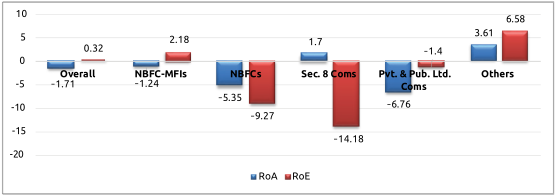
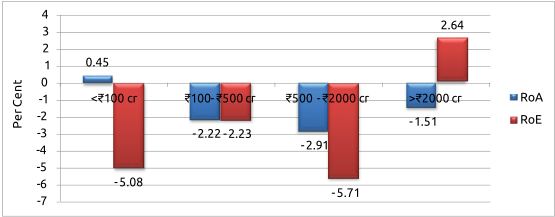
FY 2024-25 saw a drop in RoA and RoE in all legal forms and sizes. Figure 4.4.5 indicates the changes in RoA and RoE over various sizes of MLIs.
Figure 4.4.5: Return on Asset (ROA) and Return on Equity (ROE) of MLI: Size-wise
2 RoA = Net Profit/Average Asset
RoE = Net Profit/Average Equity
Conclusion
The analysis of self-sustainability and profitability in Indian microfinance highlights both resilience and challenges. While regulatory support and innovation have enabled outreach, negative surpluses and declining profitability ratios pose a threat to long-term stability. Operational Self-Sufficiency at 104% shows that institutions are only marginally covering costs, with some falling short. The fall in RoA and RoE underscores pressure on efficiency and shareholder returns. Sustaining growth will require MFIs to enhance portfolio quality, diversify income, and control costs while safeguarding affordability. Achieving balanced profitability is crucial for attracting investment, strengthening resilience, and continuing to serve low-income households sustainably.
Box 4.1: End-to-End Digital Transformation in Microfinance Lending
Midland Microfin Ltd., one of India’s leading microfinance institutions, exemplifies how responsible lending can be scaled up through digital transformation. By embracing modern technology across its operations, Midland has successfully built a digitally enabled, transparent, and customer-centric lending ecosystem.
Key Pillars of Transformation:
- End-to-End Digitization: From customer onboarding and credit appraisal to loan disbursement and repayments, Midland has digitized every step of the customer journey
- Customer Empowerment: Clients can now access financial services via mobile platforms, with minimal branch dependency.
- Responsible Lending Embeded: Transparency, affordability checks, borrower education, and data security are integral to every digital initiative.
- Increased Financial Inclusion: Technology enables outreach to underserved communities in rural and semi-urban areas, deepening financial access and trust.
Outcome and value added to the organization with the implementation of digital initiatives in FY 2024–25
1. Modern Cloud Infrastructure
The organisation has transitioned from traditional on-premises servers to advanced cloud-based platforms. This initiative has reduced dependency on physical infrastructure, improved scalability of operations, enhanced agility, and strengthened system availability, while also resulting in significant savings on infrastructure and maintenance costs.
2. Digital Communication Channels (WhatsApp, Chat-Bots, Alerts, Interactive Voice Response, and LED Displays)
Multiple digital communication platforms have been introduced to strengthen engagement with customers. Additionally, Panasonic LED display screens have been installed across branches for both internal and external communication. These measures enable real-time updates, build stronger customer connections, improve financial literacy, enhance brand visibility, and reduce communication costs.
3. Know Your Customer and Anti-Money Laundering Screening (Screenzaa Solution)
Customer due diligence processes have been reinforced by integrating screening against Politically Exposed Persons and global sanctions lists during customer onboarding. This ensures compliance with regulatory requirements, prevents onboarding of high-risk profiles, and increases transparency in customer verification.
4. Finconnect Customer Grievance Redressal Mechanism
A digital grievance redressal system has been deployed to ensure that customer complaints are resolved within one business day. This has considerably reduced turnaround time, strengthened adherence to service commitments, improved customer satisfaction levels, and lowered the manual effort and operational costs associated with complaint handling.
5. Information Technology Asset Management System
A centralized system has been implemented to monitor and manage the complete lifecycle of technology assets and inventories. The system provides visibility and control over assets, reduces redundancies, optimizes operational costs, and enhances audit and compliance readiness.
6. Midfin Customer Service Mobile Application Enhancements
The customer mobile application has been upgraded with additional self-service features. Customers can now apply for loans, track their loan status, make digital repayments, access multilingual support, and obtain digital receipts. These enhancements increase transparency and convenience, expand financial accessibility, and reduce dependency on physical branches.
7. Midfin Collection Tool
A specialized monitoring tool has been introduced to improve the management of nonperforming loans. It enables early identification of overdue accounts, tracks “Promise to Pay” commitments, and enhances visibility into arrears. This improves the efficiency of loan recovery and reduces the overall incidence of non-performing assets
8. Tableau Reporting and Analytics System
A centralized reporting and analytics platform has been adopted to provide comprehensive visibility of business data at all organizational levels. This system enables faster, data-driven decision-making, improves accuracy of reporting, and reduces reliance on manual reporting processes, thereby optimizing efficiency.
In addition to the above-mentioned initiatives, the company has identified several more digital interventions that will be taken up during this financial year to further strengthen efficiency and customer experience.
Midland Microfin Ltd. continues to pioneer responsible digital microfinance by merging innovation with inclusion. With a robust pipeline of digital initiatives, the company is setting new standards in customer experience, operational excellence, and ethical lending practices. The transformation is not just technological—it is social, sustainable, and scalable