


Chapter 6BEmergency Healthcare Financing Solutions Through Micro Lending Institutions (MLIs)
Access to healthcare is critical to good health. Healthcare access is important for overall physical, social, and mental health status of the people. Timely health care helps in detection, diagnosis, and treatment of illness thereby improving the quality of life and life expectancy of population. Rural residents often encounter barriers to healthcare that limit their ability to obtain the care they need. A data from National Family Health Survey (NFHS) shows that the rural people live less by 5 years than their urban counterparts, although the rural populace have better environment and life quality. Similarly, another data point show that 80% of medical facilities are urban and are in private. Whereas rural sector has only 20% of medical facilities, although the rural population account for nearly 70% population.

Emergency Healthcare Financing Solutions Through Micro Lending Institutions (MLIs)
6B.1: Background and Context
Access to healthcare is critical to good health. Healthcare access is important for overall physical, social, and mental health status of the people. Timely health care helps in detection, diagnosis, and treatment of illness thereby improving the quality of life and life expectancy of population. Rural residents often encounter barriers to healthcare that limit their ability to obtain the care they need. A data from National Family Health Survey (NFHS) shows that the rural people live less by 5 years than their urban counterparts, although the rural populace have better environment and life quality. Similarly, another data point show that 80% of medical facilities are urban and are in private. Whereas rural sector has only 20% of medical facilities, although the rural population account for nearly 70% population.
As per NFHS-5, under-five mortality1 and infant mortality2 are considerably higher in rural areas than in urban areas. NFHS-5 also notes the current pattern in the epidemiological trend in India shows that non-communicable diseases are now taking more of a toll on the health of the Indian population, while the problem of endemic and re-emerging infectious diseases still persists. In fact, the prevalence of chronic diseases like cardiovascular diseases, diabetes, chronic respiratory diseases (like asthma and COPD), and cancer is a growing concern in India, contributing significantly to mortality and disability. About 2.6 percent rural population seeks hospitalization (excluding child birth) in a year, more than 50 per cent of them in private hospitals. Coverage of health insurance or financing scheme in India is far from satisfactory. At least one usual household member is covered under any health insurance or financing scheme in over 41% of households.
6B.2: Gaps in Pradhan Mantri Jan Arogya Yojana (PM-JAY) Scheme
Pradhan Mantri Jan Arogya Yojana (PMJAY) scheme, launched in 2018, is a health assurance scheme which aims at providing a health cover of Rs. 5 lakhs per family per year for secondary and tertiary care hospitalization. The households included are based on the deprivation and occupational criteria of Socio- Economic Caste Census 2011 (SECC 2011). Though the progress of issuance of PMJAY cards has been impressive with more than 40.8 crore Ayushman cards issued as of May 2025, the scheme is not able to cover all health expenses of all rural poor.
| Area | Why PM-JAY Is Not Fully Sufficient |
|---|---|
| Primary healthcare | PMJAY does not cover outpatient care (OPD), diagnostics, or medicines—these form the bulk of routine healthcare expenses. |
| Out-of-pocket expenses | According to the NSSO and National Health Accounts data, over 60% of healthcare expenses are still paid out-of-pocket, mainly for outpatient care and medicines. |
| Non-covered services | Mental health, chronic disease management, rehabilitation, and long-term care are largely excluded. |
| Access and Awareness | Many eligible households are not aware or do not use the scheme effectively. Rural and remote areas may lack empanelled facilities. |
| Quality of care | Variability in the quality and availability of services across states and between public and private hospitals. |
| Private hospital participation | Some private hospitals hesitate to join due to low package rates, leading to limited choices in some regions. |
Given the poor penetration of (less than two percent) health insurance schemes in rural India, and the fact that many of them are covered under Ayushman card may not cover all the medical and non-medical expenses, villagers may have to fall back on borrowings for meeting such health emergencies.
6B.3: Leveraging Microfinance Platform to Access Health Interventions
Access to timely, affordable emergency healthcare is paramount to improving the health outcome and financial resilience of rural households. When household members get sick, they are slightly more likely to seek care in the public sector than the private sector. As per NFHS-5 data, poor quality of care, long waiting time at government facilities, and/or presence of government facility nearby is cited as the reason for not seeking health care from public sector by the rural households in India. About 63% of total health expenses in India are out-of-pocket, which push around 5.5 crore people into poverty every year. About 23% of rural households resort to informal loans to cover medical expenses. In such a scenario providing pre-sanctioned healthcare loan is much needed for the population segment catered by the MLIs. It will not only help villagers get treatment from a reliable medical provider, at affordable prices, as quickly and nearby as possible but also improve their life expectancy and well-being. This improved well- being has a direct impact on their livelihood and income generation capability. MLIs with its vast network in the bottom of pyramid allows an attractive proposition of layering health initiatives within its operation to improve the financial protection and improve the health status of microfinance members.
Box 6B.1: Infrastructure Development and Public Amenities - Construction of Toilet Complex in Rural Schools
To encourage sustainable development in rural areas, VFS Capital carries out community infrastructure projects with funding support from Narayana Health.
Under the Project Preserving Happiness, funding for Water Sanitation and Hygiene (WASH) is supported as an essential endeavour that seeks to improve the lives and education of students, particularly girls. At the heart of this project is the refurbishment of existing sanitation facilities for girls in rural schools, surpassing basic hygiene standards. Additionally, it ensures that students have a reliable and safe source of clean water within the school grounds whenever they need it, thus improving water accessibility. Moreover, the WASH Project is in line with broader global development objectives, specifically the Sustainable Development Goals (SDGs) established by the United Nations. By prioritizing access to clean water, sanitation, and hygiene education, the initiative directly contributes to SDG 4 (Quality Education), SDG 5 (Gender Equality), and SDG 6 (Clean Water and Sanitation). The project’s significance extends beyond its local impact as it aligns with global endeavours to create a more equitable and sustainable future.
It also aims to enhance health and well- being while reducing inequalities.
The WASH Project has a positive impact on different people and communities, including girl students, teachers, administrators, support staff, and the local community. Its primary objective is to meet the specific requirements of girl students, who often encounter obstacles because of inadequate WASH infrastructure. By enhancing their ability to obtain clean water, sanitation facilities, and hygiene education, the project directly improves the health, dignity, and educational prospects of these girls.
Key highlights of this initiative are:
- 11 complexes have been constructed.
- No. of Beneficiaries: 22,000
- Name and number of states covered: 1 (West Bengal)
- Name and number of the districts covered: 4 (Howrah, Hooghly, North 24 Parganas, South 24 Parganas)
- Amount Incurred: ₹32,00,000
Courtesy: VFS Capital Ltd.
6B.4: Emergency Health Loan Model
Considering the unfulfilled need for emergency health loan for micro-borrowers in rural areas, Sa-Dhan along with App based company facilitating medical facilities to rural populace, MedoPlus entered into a strategic partnership to jointly address healthcare access challenges in rural areas. This partnership aims to leverage the strengths of both organizations to design, pilot, and scale the Emergency Health Loan model.
Box 6B.2: Emergency Health Loan (EHL) Initiative
Bridging the Healthcare Financing Gap for Rural India
Access to timely and appropriate healthcare remains a significant challenge for marginalized rural populations in India. The key issues faced by rural households, especially microfinance clients, include:
- Lack of Immediate Funds: Medical treatments are often delayed due to the absence of readily available money.
- Non-availability of Health Loans: Financial products tailored to emergency healthcare needs are missing.
- Resulting Impact: Villagers in rural India have a life expectancy nearly five years lower than their urban counterparts due to treatment delays and inadequate care.
Proposed Solution: Multi-Pronged Approach
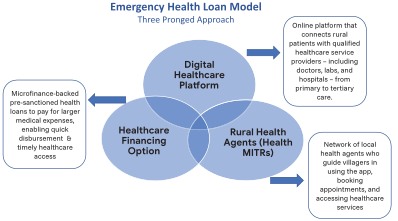
- Digital Healthcare Platform: A technology solution to provide access to qualified healthcare providers from nearby urban areas.
- Rural Health Agents (Health MITRs): Trained community agents who guide villagers in using the app, booking appointments, and access- ing healthcare services.
- Emergency Health Loans: Microfi- nance-backed health loans to ensure villagers can afford treatment when needed.
Strategic Partnership: MedoPlus & Sa- Dhan
A Memorandum of Understanding (MoU) has been signed between Sa-Dhan and MedoPlus to jointly address healthcare access challenges in rural areas. This partnership aims to leverage the strengths of both organizations to design, pilot, and scale the Emergency Health Loan model.
Roles & Responsibilities
Sa-Dhan’s Role: Sa-Dhan focuses on developing the financial framework and driving the implementation of the Emergency Health Loan initiative. It identifies MFIs for pilot participation and defines parameters for emergency and pre-sanctioned health loans, including appraisal, sanctioning, and monitoring processes. Sa-Dhan ensures regulatory compliance, standardizes loan norms, and conducts workshops to refine product design. It trains MFI branches, builds and manages a network of Health Agents, and monitors their performance. Sa-Dhan leads overall project management, maintains reports and documentation, and promotes the finalized loan product across the MFI network for broader adoption.
MedoPlus’s Role: MedoPlus leads the technology and community engagement aspects. It has recruited and trained 200 Health Agents (MedoMITRs) in app usage, healthcare services, and health loan promotion. These agents use the MedoPlus App to assist villagers in accessing healthcare and financial services. MedoPlus develops and maintains the digital platform, integrates APIs, and manages digital device procurement. It onboards hospitals, trains providers, and drives awareness through community outreach and social media. MedoPlus also gathers field data to support loan design, facilitates smooth data flow with MFIs, and provides ongoing project leadership and operational support.
Current Progress
- A Pilot is underway at Bulandshahar, Western UP, where leads are being generated for MFIs to scrutinize and disburse loans to patients who need immediate hospitalization.
- MedoPlus has invested significantly in platform development, device procurement, and recruitment of MedoMITRs, who now manage lead generation and community engagement.
- While digital integration with MFIs (via APIs) is planned post process stabilization, current operations rely on manual data collection and sharing.
- Both organizations are collaborating closely to refine processes and prepare for full-scale implementation.
Conclusion
The EHL initiative is a unique collaboration between financial and healthcare sectors to address a critical rural need: access to affordable, timely healthcare. By combining digital tools, community agents, and innovative financing, the partnership aims to create a sustainable, scalable solution for rural India’s healthcare challenges.
Impact achieved so far
Targeting people living in rural villages with 2,000 to 3,500 residents, MedoPlus had 255,000 registered villagers in the state of Uttar Pradesh as of May 2023. MedoPlus has invested significantly in platform development, device procurement, and recruitment of MedoMITRs, who now manage lead generation and community engagement. A Pilot is underway at Bulandshahar, Western UP, where leads are being generated for MLIs to scrutinize and disburse loans to patients who need immediate hospitalization. Both organizations are collaborating closely to refine processes and prepare for full-scale implementation.
6B.5: Benefits for MLIs by Financing Healthcare Solutions
MLIs can engage in cooperative and collaborative partnerships with health organizations for expanding social and health outcomes at the bottom of the pyramid. MLIs, with their vast network, has the potential to improve livelihoods of the poor and can offer a platform to achieve the long-term outcome of improved life expectancy and financial inclusion in the underserved areas. Some specific benefits for MLIs include,
Enhanced Social Impact: Emergency Health Loan product can become a strong tool to establish MLIs as saviours and “friends in need” within the communities where they are working. The common view increasingly becoming popular that MLIs are losing the pro-poor and common-good stance, can be addressed by rolling out such products that have a balanced financial and social-sector focus.
Improved Portfolio Quality: Out-of-pocket expenditure in obtaining medical treatment depletes the household income of borrowers served by MLIs. By increasing the disposable income of the household by financing healthcare loans, MLIs borrowers will have adequate cash to repay the loans taken by them. This reduces the risk of loan defaults for the MLIs, improving their portfolio quality.
Portfolio Diversification: By offering emergency health loans, MLIs are able to spread their risk instead of concentrating solely on traditional income-generating loans. Thereby providing them with an effective risk mitigation strategy and help in portfolio stability in the event of economic downturns or sector-specific risks as the institution’s portfolio is not tied to a single product line.
Access to New Funding Sources: Healthcare financing solutions supports progress towards SDG 3: Good Health and Well-being. Thus, working on interventions that promotes SDG agenda gives MLIs opportunity to avail grants and CSR from impact investors/donors by operating in cooperative and collaborative partnerships with organizations for expanding health and social services.
Increased Client Outreach: Emergency Health Loan products can attract clients who may not have previously engaged with MLIs but require urgent medical financing, thereby increasing MLIs market and client outreach.
6B.6: Conclusion
The Emergency Health Loan product holds immense potential for MLIs not only in monetary terms but also to establish them once again as social development focused institutions. Currently, borrowers have other options such as PM-Jan Arogya Yojana, moneylenders, friends, and relatives to meet their financial needs in times of health emergency. However, these are either insufficient or costly/inefficient. Moreover, not everybody wants to borrow money from friends and relatives. Therefore, MLIs stepping forward as trustworthy institutions who are not only lending money for income-generation or consumption, but are ready to lend for emergencies, can go a long way in strengthening the bond with the community and re-establishing the trust between community and the organization through its field staff.
Box No 6B.3: SAVE’s Initiative of eye care saves lives by providing light in their lives – an initiative of health care
Background
To support the poor and needy, Save Microfinance launched an NGO named Care for Health under the Save Roshni Project, funded by SAVE. As part of this initiative, Care for Health organizes eye screening camps in various localities, offering free services to underprivileged communities.
Through these camps, many individuals have received vital support—among them are Girish Chandra Sarkar, a senior citizen from Delhi, and Mohan Lal, a 45-year-old driver. Their cases stand as examples of how this initiative is making a real difference in the lives of those in need.
Girish Chandra Sarkar, a senior citizen residing in Delhi, had gradually lost his vision due to cataracts in both eyes. With deteriorating eyesight, he became heavily dependent on his elderly wife for even the most basic tasks. Despite having two sons and a daughter, none came forward to support him in his time of need. His loss of vision severely eroded his confidence— turning everyday activities like walking or using the washroom into painful struggles.
In a different corner of the region, Mohan Lal, a 45-year-old driver living in Noida, faced his own battle. Originally from a remote village near Lucknow, he had left home at a young age in search of work and a better future. Unmarried and with no close family nearby, his life revolved entirely around his ability to drive. But over the past year, cataracts threatened not just his sight—but his livelihood. With limited savings and no support system, Mohan Lal was unsure of whom to trust for such a critical need.
Through Care for Health’s eye screening camp, both Girish and Mohan Lal received the attention and care they desperately needed. Their cases serve as powerful reminders of how accessible healthcare can restore dignity, independence, and hope to those who are too often forgotten.
Type of Intervention
The Save Roshni Project was launched to reach the unreached — the daily wage earners, migrant workers, and underprivileged who suffer in silence due to curable blindness. This health care initiative covers the following facilities:
- Detailed medical screening and counselling
- Complex cataract surgery for one eye (first stage)
- Free medication, post-op care, and home visit follow-up
- Planning for the second eye at a safer interval
Outcomes
Post-surgery, both the beneficiaries regained clear vision. Now they can move around, earn their livelihoods, and do day-to-day work independently,
Impact
The impact goes beyond clinical results. The Save Roshni Project truly saved their ‘roshni’ (vision), restored dignity, livelihood, trust, and human connection. Today, they are a living example of how timely and compassionate healthcare can breathe life into forgotten lives. They urge others in their colonies not to delay treatment and often greet our team with folded hands and moist eyes.