


Chapter 7Business Correspondent Model in Microlending
The Business Correspondent (BC) model was introduced as part of the financial inclusion programme in the country, launched in 2005. The Deepak Mohanty Committee in 2015 gave a proper structure to the Business Correspondent model1 . Initially, the BC model was open to a limited number of agents, like individuals, SHGs, Societies, NGOs, etc. But soon it was extended to corporate entities to act as BCs. Thus, microfinance companies emerged as BC to several financial institutions, thereby expanding the reach of credit far and wide.

Business Correspondent Model in Microlending
The Business Correspondent (BC) model was introduced as part of the financial inclusion programme in the country, launched in 2005. The Deepak Mohanty Committee in 2015 gave a proper structure to the Business Correspondent model1 . Initially, the BC model was open to a limited number of agents, like individuals, SHGs, Societies, NGOs, etc. But soon it was extended to corporate entities to act as BCs. Thus, microfinance companies emerged as BC to several financial institutions, thereby expanding the reach of credit far and wide.
At its core, the BC model fosters partnerships between financial institutions and customers, with correspondents serving as intermediaries to expand banking access to underserved communities at the base of the socioeconomic pyramid. Over time, with advances in technology, the model has evolved into three distinct forms—physical, digital, and hybrid— reflecting the changing dynamics of the financial services industry.
Since its launch, the Business Correspondent (BC) channel has expanded rapidly, reaching millions of customers each year and playing a pivotal role in advancing financial inclusion by bridging the last mile. But the risks of fraud, weak risk management frameworks, inadequate capacity-building, limited visibility, absence of a centralised database, and underutilization of new technologies are some of the concerns of this model. Addressing these issues requires proactive participation and strong collaboration among industry stakeholders. Only through collective vision, planning, and coordinated action the BC model can overcome barriers to growth. Encouragingly, the industry has already begun working together to design efficient, scalable, and future-ready solutions supply2 .
Alongside technological progress, a new class of enterprises, Loan Service Providers (LSPs), has emerged, creating fresh opportunities for financial institutions to diversify partnerships beyond the traditional BC model. Unlike BCs, LSPs operate mainly in the digital space, with a strong focus on customer acquisition, credit underwriting, and initial service delivery, while playing a more limited role in long-term customer relationship management.
The banking sector in India had been leveraging the Business Correspondent (BC) model to drive retail credit growth, especially in deeper areas with newly included bank account holders. By integrating digital payment data with BC-led activities, such as lead generation, follow-up, and collections, the banks have been able to strengthen credit outreach across MSMEs, SHGs, agriculture, and retail segments. Promoting their own UPI apps and QR codes among traders, service providers, and institutions will create valuable data trails, enabling more accurate credit assessments. With trained BC agents facilitating customer engagement and collections, this approach can significantly enhance financial inclusion while fuelling sustainable credit expansion in the microfinance space3.
Rural India has also been witnessing a digital finance revolution powered by UPI, Aadhaar-enabled services, and Business Correspondent (BC) networks. While these tools expand financial inclusion, challenges like poor connectivity, low literacy, limited trust, cybersecurity risks, and unregulated lending persist. Regulatory initiatives, such as the Payments Infrastructure Development Fund, data protection norms, and pilots like the Unified Lending Interface (ULI), can help address these gaps. Strengthening connectivity, empowering BC Sakhis, improving literacy, ensuring cybersecurity, and regulating lenders—alongside innovations like ONDC—can unlock inclusive, resilient, and equitable digital finance for rural India.
7.1 Progress in Financial Inclusion
In 2021, the Reserve Bank of India (RBI) introduced the composite Financial Inclusion Index (FI-Index) to measure financial inclusion nationwide. The index is based on three parameters—Access (35%), Usage (45%), and Quality (20%)—covering 97 indicators. Notably, the Quality dimension captures financial literacy, consumer protection, and service gaps. As of March 2025, the FI-Index rose to 67.0 from 64.2 in March 2024, with improvements across all sub-indices. The rise was driven mainly by greater Usage and Quality, reflecting deeper financial inclusion and the impact of sustained literacy initiatives4 . The role of BC agents in this regard is vital.
The following is a summary of BC led financial inclusion progress in the country.
Table 7.1: Financial Inclusion Plan-Summary Progress of all Banks, including RRBs
| Particulars | March 2010 | December 2023 | December 2024 | Change between Dec’23 and Dec’24 |
|---|---|---|---|---|
| Banking Outlets in Villages – Branches | 33,378 | 53,893 | 56,579 | 2,686 |
| Banking Outlets in Villages – BCs | 34,174 | 15,92,598 | 13,55,591 | -2,37,007 |
| Urban Locations covered through BCs | 447 | 3,58,167 | 3,67,712 | 9,545 |
| Basic Savings Bank Deposit A/c through branches (No. in lakh) | 600 | 2,780 | 2,743 | -37 |
| Basic Savings Bank Deposit A/c through branches (₹ in crore) | 4,400 | 1,35,628 | 1,45,883 | 10,255 |
| Basic Savings Bank Deposit A/c through BCs (No. in lakh) | 130 | 4,274 | 4,458 | 184 | Basic Savings Bank Deposit A/c through BCs (₹ in crore) | 1,100 | 1,36,558 | 1,58,832 | 22,274 |
| BSBDA-Total (No. in lakh) | 730 | 7,054 | 7,201 | 147 |
| BSBDA Total (₹ in crore) | 5,500 | 2,72,186 | 3,04,715 | 32,529 |
| OD facility availed in BSBDAs (No. in lakh) | 2 | 53 | 45 | -8 |
| OD facility availed in BSBDAs (₹ in crore) | 10 | 579 | 548 | -31 |
| KCCs (No. in lakh) | 240 | 507 | 520 | 13 |
| KCCs (₹ in crore) | 1,24,000 | 8,11,906 | 8,85,068 | 73,162 |
| GCC (No. in lakh) | 10 | 55 | 22 | -33 |
| GCC (₹ in crore) | 3,500 | 53,690 | 36,312 | -17,378 |
| ICT-A/Cs-BC Transactions (No. in lakh) | 270 | 27,294 | 29,944 | 2,650 |
| ICT-A/Cs-BC Transactions (₹ in crore) | 700 | 9,86,236 | 10,73,073 | 86,837 |
4 https://rbi.org.in/scripts/BS_PressReleaseDisplay.aspx?prid=60875
Source: RBI55
7.2 MLIs as Business Correspondents -Credits operations
While the BC model is primarily adopted by banks in the liability side, over the years, there has been a growing shift towards the assets side too, especially in lending for smaller loans. In this regard, the Microlending institutions (MLI) play a major role. The pandemic dealt a severe blow to MLIs, causing a sharp rise in delinquencies. Subsequent regulatory changes, such as revised risk weightages and scale-based norms for NBFCs, combined with weakening investor sentiment, led to a significant slowdown in funding for the sector. To ensure steady fund flows and maintain business continuity, many MLIs increasingly turned to be the BC agents of banks and Small Finance Banks and even larger NBFCs. This trend is evident in the rising number of MLIs operating under the BC framework and the expanding BC portfolio, as seen in table 7.2.
Table 7.2: Trend of the number of MLIs in Business Correspondents (BC)
| Year | No. of MLIs | Growth (in %) |
|---|---|---|
| 2017 | 49 | 227% |
| 2018 | 57 | 16% |
| 2019 | 58 | 2% |
| 2020 | 72 | 24% |
| 2021 | 666 | -8% |
| 2022 | 77 | 17% |
| 2023 | 81 | 5% |
| 2024 | 104 | 28% |
| 2025 | 907 | -13% |
Out of the 90 MLIs, 19 are exclusively operating as business correspondent partners for banks and SFBs. The total borrowers served by these MLIs are 69.08 lakhs with a portfolio outstanding of ₹34,159 crores.
5https://rbi.org.in/scripts/AnnualReportPublications.aspx?Id=1434
6 Incomplete data
7 Data is based on the 202 MLIs which is lower than last year i.e., 216. The difference in number is due to the change in reporting MLIs. In reality, this number could be higher than last year.
Table 7.3: MLIs which are exclusively Business Correspondents (BC) as on 31 March 2025
| S. No. | Name of MLIs | BC Borrowers (in lakhs) |
No. of Clients (in ₹ crores) |
|---|---|---|---|
| 1 | Citta Plus Consultancy Pvt. Ltd. | 0.27 | 71 |
| 2 | Dhosa Fincare Pvt. Ltd. | 0.64 | 158 |
| 3 | Fingel Management Services Pvt. Ltd. | 0.08 | 13 |
| 4 | Finsigma Inclusive Services Pvt. Ltd. | 0.30 | 79 |
| 5 | Kamal Fincap Pvt. Ltd. | 2.83 | 638 |
| 6 | PAFT Inclusive Financial Services Pvt. Ltd. | 2.16 | 547 |
| 7 | Pragati Finserv Pvt. Ltd. | 3.92 | 1,032 |
| 8 | Shikhar Urban and Rural Pvt. Ltd. (SURE) | 0.51 | 164 |
| 9 | Aarthsiddhi Services Pvt. Ltd. | 0.22 | 55 |
| 10 | Sampurna Business Correspondence Pvt. Ltd | 0.73 | 181 |
| 11 | Save Financial Managements Pvt. Ltd. | 1.48 | 439 |
| 12 | Sampurna Financial Services Pvt. Ltd. | 1.16 | 302 |
| 13 | Sub-K IMPACT Solutions Ltd. | 3.61 | 790 |
| 14 | New Opportunity Consultancy Pvt. Ltd. | 11.33 | 2,489 |
| 15 | Ambition Services Pvt. Ltd. | 0.94 | 204 |
| 16 | Swabhimaan Finance Pvt. Ltd. | 1.86 | 530 |
| 17 | Gramalaya Microfin Foundation (GMF) | 0.24 | 74 |
| 18 | Shri Kshethra Dharmasthala Rural Development Project (SKDRDP) | 36.35 | 26,259 |
| 19 | Bargach Finance Pvt. Ltd. | 0.47 | 133 |
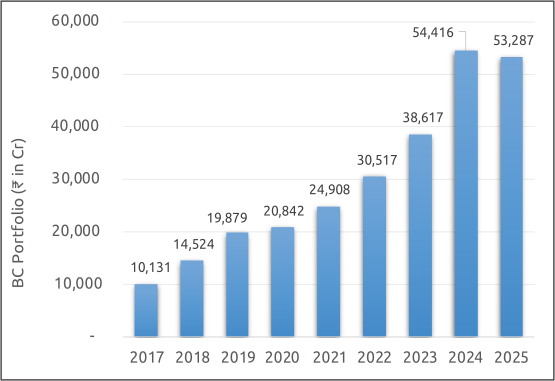
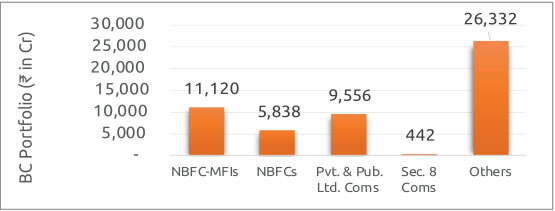
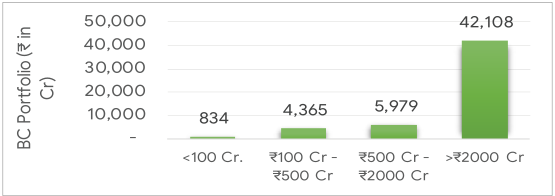
The total BC portfolio of 90 MLIs stands at ₹ 53,287 crores, with a base of 129.61 lakh borrowers. The share of the portfolio under the BC model is 22% of the total portfolio outstanding of the MLIs
Figure 7.1: Trend of BC Loan Portfolio and Category–wise breakup for 2024-25
7.3 Leading MLIs with BC Portfolio
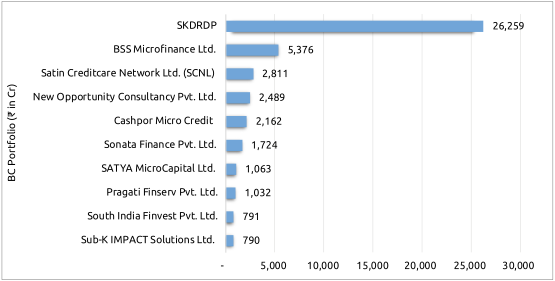
The top 10 MLIs in terms of BC portfolio contribute to 84% of the total BC portfolio. Among these SKDRDP itself contributes to 49% of the total BC Portfolio of the MLIs.
Figure 7.2: List of Top 10 MLIs with BC Portfolio (₹ in Cr.) as of March 2025
7.4 Portfolio of MLIs under BC Model
The MLIs, which act as BCs, are either associated with one lender exclusively or with more lenders at the same time. There are several MLIs engaged with more than 1 lending institution. The maximum is 16 lenders connected with a single MLIs, i.e. NOPCL, which is an exclusive BC company. However, the average is around 6 banks/FIs engaged with a single MLI.
Table 7.4: MLI-wise data on BC portfolio
| S.No. | Name of MLIs | Legal Form | Lending partners | Total BC Portfolio (in ₹ cr) |
|---|---|---|---|---|
| 1 | Aarthsiddhi Services Pvt. Ltd. | Pvt. Ltd. Com | 3 | 55.36 |
| 2 | Aasra Fincorp Pvt. Ltd. | NBFC-MFI | 1 | 4.01 |
| 3 | Agora Microfinance India Ltd. | NBFC-MFI | 1 | 1.27 |
| 4 | Ambition Services Pvt. Ltd. | Pvt. Ltd. Com. | 5 | 204.26 |
| 5 | Annapurna Finance Pvt. Ltd. | NBFC-MFI | 1 | 121.52 |
| 6 | Aparajita Mahila Sangh | Society | 1 | 1.92 |
| 7 | ASA International India Microfinance Pvt. Ltd. | NBFC-MFI | 5 | 279.53 |
| 8 | Aviral Finance Pvt. Ltd. | NBFC-MFI | 1 | 9.24 |
| 9 | Bargach Finance Pvt. Ltd. | Pvt. Ltd. Com. | 5 | 133.25 |
| 10 | BSS Microfinance Ltd. | NBFC | 1 | 5,376.11 |
| 11 | BWDA Finance Ltd. | NBFC-MFI | 2 | 311.44 |
| 12 | Cashpor Micro Credit | NBFC-MFI | 6 | 2,161.57 |
| 13 | Centre for Development Orientation and Training (CDOT) | Society | 1 | 17.20 |
| 14 | Citta Plus Consultancy Pvt. Ltd. | Pvt. Ltd. Com. | 3 | 70.73 |
| 15 | Community Collective Society for Integrated Development (CCFID) | Society | 2 | 38.45 |
| 16 | Dhosa Fincare Pvt. Ltd. | Pvt. Ltd. Com. | 2 | 158.20 |
| 17 | Disha India Micro Credit (DIMC) | Sec. 8 Com. | 4 | 146.59 |
| 18 | Dvara Kshetriya Gramin Financial Services Pvt. Ltd. | NBFC | 5 | 28.86 |
| 19 | Fingel Management Services Pvt. Ltd. | Pvt. Ltd. Com. | 8 | 12.66 |
| 20 | Finsigma Inclusive Services Pvt. Ltd. | Pvt. Ltd. Com. | 5 | 79.35 |
| 21 | Friends Capital Services Ltd. (FCSL) | NBFC | 1 | 0.19 |
| 22 | G U Financial Services Pvt. Ltd. | NBFC-MFI | 3 | 43.18 |
| 23 | Glowmore Finance Pvt. Ltd. | NBFC | 1 | 1.38 |
| 24 | Gramalaya Microfin Foundation (GMF) | Sec. 8 Com. | 5 | 73.73 |
| 25 | Grameen Development and Finance Pvt. Ltd. | NBFC-MFI | 2 | 39.09 |
| 26 | Grameen Shakti Microfinance Services Pvt. Ltd. | NBFC-MFI | 6 | 97.91 |
| 27 | Hindusthan Microfinance Pvt. Ltd. (HMPL) | NBFC-MFI | 4 | 33.58 |
| 28 | Humana Financial Services Pvt. Ltd. | NBFC-MFI | 2 | 101.18 |
| 29 | IDF Financial Services Pvt. Ltd. | NBFC-MFI | 4 | 33.33 |
| 30 | Jagaran Microfin Pvt. Ltd. | NBFC-MFI | 4 | 153.31 |
| 31 | Janakalyan Financial Services Pvt. Ltd. | NBFC-MFI | 5 | 177.24 |
| 32 | Jigyasa Livelihood Promotions Micro Finance Foundation | Sec. 8 Com. | 4 | 17.37 |
| 33 | Kamal Fincap Pvt. Ltd. | Pvt. Ltd. Com. | 6 | 638.38 |
| 34 | Kiara Microcredit Pvt. Ltd. | NBFC-MFI | 3 | 8.02 |
| 35 | LaRaksha Impact Finance Enterprises Pvt. Ltd. | NBFC | 1 | 6.02 |
| 36 | LaRaksha Social Impact Trust | Trust | 1 | 0.96 |
| 37 | M Power Micro Finance Pvt. Ltd. | NBFC-MFI | 2 | 55.91 |
| 38 | Magalir Micro Capital Pvt. Ltd. | NBFC-MFI | 3 | 58.13 |
| 39 | Magenta Finance Services Pvt. Ltd. | NBFC-MFI | 1 | 1.04 |
| 40 | Magilchi Foundation | Trust | 3 | 4.21 |
| 41 | Mitrata Inclusive Financial Services Ltd. | NBFC-MFI | 4 | 46.33 |
| 42 | Muthoot Microfin Ltd. | NBFC-MFI | 1 | 74.61 |
| 43 | Navachetana Microfin Services Pvt. Ltd. | NBFC-MFI | 6 | 75.10 |
| 44 | New Opportunity Consultancy Pvt. Ltd. | Pub. Ltd. Com. | 16 | 2,488.66 |
| 45 | Nightingale Finvest Pvt. Ltd. | NBFC-MFI | 5 | 105.92 |
| 46 | PAFT Inclusive Financial Services Pvt. Ltd. | Pvt. Ltd. Com. | 2 | 547.37 |
| 47 | Pahal Financial Services Pvt. Ltd. | NBFC-MFI | 5 | 315.76 |
| 48 | Palli Pragoti Financial Services Pvt. Ltd. | NBFC | 1 | 6.64 |
| 49 | Pragati Finserv Pvt. Ltd. | Pvt. Ltd. Com. | 1 | 1,031.53 |
| 50 | Pratyancha Financial Services Ltd. | NBFC | 3 | 11.85 |
| 51 | Prayas Financial Services Pvt. Ltd. | NBFC-MFI | 1 | 273.74 |
| 52 | Prayatna Microfinance Ltd. | NBFC-MFI | 1 | 12.71 |
| 53 | RORS Finance Pvt. Ltd. | NBFC-MFI | 1 | 1.01 |
| 54 | S V Creditline Pvt. Ltd. (SVCL) | NBFC-MFI | 1 | 397.12 |
| 55 | Sahyog Development Services | Sec. 8 Com. | 2 | 109.41 |
| 56 | Samavesh Finserve Pvt. Ltd. | NBFC-MFI | 6 | 23.23 |
| 57 | Samhita Community Development Services | Sec. 8 Com. | 2 | 80.80 |
| 58 | Sampada Entrepreneurship & Livelihoods Foundation (SELF) | Sec. 8 Com. | 1 | 2.82 |
| 59 | Samparna Business Correspondence Pvt. Ltd. | Pvt. Ltd. Com. | 3 | 180.83 |
| 60 | Sampurna Financial Services Pvt. Ltd. | Pvt. Ltd. Com. | 4 | 301.67 |
| 61 | Sarala Development & Microfinance Pvt. Ltd. | NBFC-MFI | 5 | 171.64 |
| 62 | Satin Creditcare Network Ltd. (SCNL) | NBFC-MFI | 1 | 2,593.86 |
| 63 | SATYA MicroCapital Ltd. | NBFC-MFI | 1 | 1,063.07 |
| 64 | Save Financial Managements Pvt. Ltd. | Pvt. Ltd. Com. | 10 | 438.81 |
| 65 | SEED Capital Pvt. Ltd. | NBFC | 1 | 10.25 |
| 66 | Self-Employment Voluntary Association (SEVA-Manipur) | Society | 1 | 11.43 |
| 67 | Servitium Micro Finance Pvt. Ltd. | NBFC-MFI | 2 | 42.74 |
| 68 | Share Microfin Ltd. | NBFC-MFI | 3 | 110.49 |
| 69 | Shikhar Urban and Rural Pvt. Ltd. (SURE) | Pvt. Ltd. Com. | 2 | 164.33 |
| 70 | Shri Kshethra Dharmasthala Rural Development Project (SKDRDP) | Trust | 6 | 26,258.87 |
| 71 | Sindhuja Microcredit Pvt. Ltd. | NBFC-MFI | 2 | 244.09 |
| 72 | Sonata Finance Pvt. Ltd. | Pvt. Ltd. Com. | 3 | 1,723.76 |
| 73 | South India Finvest Pvt. Ltd. | NBFC-MFI | 3 | 790.52 |
| 74 | Srifin Credit Pvt. Ltd. | NBFC-MFI | 3 | 115.36 |
| 75 | Sub-K IMPACT Solutions Ltd. | Pub. Ltd. Com. | 10 | 790.45 |
| 76 | Sugmya Finance Pvt. Ltd. | NBFC | 5 | 94.76 |
| 77 | Sushravya Upliftment Foundation | Sec 8 Com. | 2 | 3.49 |
| 78 | Svasti Microfinance Pvt. Ltd. | NBFC-MFI | 3 | 9.87 |
| 79 | Swabhimaan Finance Pvt. Ltd. | Pvt. Ltd. Com. | 3 | 530.26 |
| 80 | Swarnodhayam Credits Pvt. Ltd. | NBFC | 3 | 20.62 |
| 81 | UNACCO Financial Services Pvt. Ltd. | NBFC-MFI | 1 | 37.42 |
| 82 | Unnatti Finserv Pvt. Ltd. | NBFC | 7 | 205.26 |
| 83 | Uttrayan Financial Services Pvt. Ltd. | NBFC-MFI | 1 | 258.77 |
| 84 | Vector Finance Pvt. Ltd. | NBFC-MFI | 6 | 290.56 |
| 85 | Velicham Finance Pvt. Ltd. | NBFC | 4 | 81.59 |
| 86 | VFS Capital Ltd. | NBFC-MFI | 4 | 254.19 |
| 87 | Virutcham Microfinance Ltd. | NBFC-MFI | 2 | 20.35 |
| 88 | WeGrow Financial Services Pvt. Ltd. | NBFC-MFI | 1 | 67.62 |
| 89 | YVU Financial Services Pvt. Ltd. | NBFC-MFI | 2 | 31.51 |
| 90 | Zylo Micro Care Foundation | Sec. 8 Com. | 4 | 7.88 |
| Total | 290 | 53,287 |
Table 7.5: Summary of MLIs having engagement with one or more Banks/FIs under BC arrangements
| 1 | 2 | 3 | 4 |
|---|---|---|---|
| No. of lenders engaged as BC partners to a Micro lending institution (MLI) | No. of such MLIs relates to col.1 | Out of 2, No. of NBFC-MFIs | Out of 2, No. of Non NBFC-MFIs |
| 1 | 27 | 15 | 12 |
| 2 | 15 | 8 | 7 |
| 3 | 15 | 7 | 8 |
| 4 | 10 | 5 | 5 |
| 5 | 11 | 5 | 6 |
| 6 | 7 | 5 | 2 |
| 7 | 1 | - | 1 |
| 8 | 1 | - | 1 |
| 10 | 2 | - | 2 |
| 16 | 1 | - | 1 |
| Total | 90 | 45 | 45 |
Table 7.6: Banks / Financial Institutions-wise data on MLIs as Banking Correspondents
| S.No. | Name of the Bank/FI | No of MLIs | Number of Loan Accounts (in lakhs) | Loan Portfolio (in ₹ cr) |
|---|---|---|---|---|
| 1 | Ananya Finance for Inclusive Growth Pvt. Ltd. | 3 | 0.99 | 277.43 |
| 2 | Annapurna Finance Pvt. Ltd. | 3 | 0.12 | 32.00 |
| 3 | Arohan Financial Services Pvt. Ltd. | 3 | 0.21 | 80.00 |
| 4 | Arthmate Finance Leasing Pvt. Ltd. | 4 | 0.02 | 12.00 |
| 5 | Arthmatetech India Pvt. Ltd. | 1 | 0.00 | 4.00 |
| 6 | Asha Vaibhav Co-op. Credit Society | 1 | 0.02 | 5.00 |
| 7 | AU SFB | 3 | 1.46 | 363.00 |
| 8 | Avanti Finance Pvt. Ltd. | 27 | 3.26 | 846.00 |
| 9 | Avanti Microfinance Pvt. Ltd. | 2 | 0.07 | 17.00 |
| 10 | Axis Bank Ltd. | 4 | 0.83 | 186.00 |
| 11 | Bank of Baroda | 1 | 9.31 | 6637.00 |
| 12 | Bank of India | 1 | 0.06 | 39.00 |
| 13 | Bank of Maharashtra | 1 | 3.25 | 1968.00 |
| 14 | CASP | 1 | 0.04 | 23.00 |
| 15 | CSB Bank Ltd. | 16 | 1.09 | 305.00 |
| 16 | DCB Bank Ltd. | 4 | 1.18 | 293.00 |
| 17 | Elecronica Finance Ltd. | 1 | 0.02 | 7.00 |
| 18 | Equitas SFB | 1 | 1.03 | 179.00 |
| 19 | ESAF SFB | 20 | 4.90 | 1377.00 |
| 20 | Fedbank Financial Services Ltd. | 1 | 0.14 | 7.00 |
| 21 | Federal Bank Ltd. | 11 | 5.24 | 1542.00 |
| 22 | Finaleap Finserv Pvt. Ltd. | 1 | 0.03 | 2.32 |
| 23 | Fincare SFB | 5 | 0.38 | 75.77 |
| 24 | Finstars Capital Ltd. | 1 | 0.01 | 1.85 |
| 25 | Godavari Finance Ltd. | 1 | 0.27 | 86.91 |
| 26 | Grow Money Capital Pvt. Ltd. | 1 | 0.01 | 1.72 |
| 27 | Habitat Micro Build India Housing Finance Co. Ltd. | 1 | 0.00 | 0.04 |
| 28 | Hinduja Leyland Finance | 1 | 0.20 | 48.97 |
| 29 | ICICI Bank Ltd. | 3 | 0.42 | 186.77 |
| 30 | IDBI Bank Ltd. | 12 | 6.82 | 4412.95 |
| 31 | IDFC First Bank Ltd. | 6 | 0.53 | 159.11 |
| 32 | India P2P | 1 | 0.04 | 11.07 |
| 33 | IndusInd Bank Ltd. | 2 | 2.31 | 817.93 |
| 34 | Jalan | 1 | 0.01 | 11.85 |
| 35 | Jana SFB | 11 | 3.20 | 1317.34 |
| 36 | Kaleidofin Capital Pvt. Ltd. (KCPL) | 7 | 0.25 | 48.81 |
| 37 | Karnataka Bank | 1 | 1.53 | 1292.96 |
| 38 | Karnataka Grameena Bank | 1 | 5.75 | 4016.16 |
| 39 | Karur Vysya Bank | 2 | 0.61 | 169.22 |
| 40 | Kissandhan Agri Financial Services Pvt. Ltd. | 1 | 0.04 | 10.58 |
| 41 | Kotak Mahindra Bank Ltd. | 4 | 21.54 | 7140.34 |
| 42 | Local Co-op Credit Societies | 1 | 0.07 | 16.61 |
| 43 | Louis Dreyfus Company (LDC) | 1 | 0.01 | 0.82 |
| 44 | LTF | 1 | 0.01 | 1.04 |
| 45 | MAS Financial Services Pvt. Ltd. | 6 | 1.35 | 518.11 |
| 46 | Monexo Fintech Pvt. Ltd | 8 | 0.08 | 23.04 |
| 47 | MVTV Sahakari Patpedhi Ltd. | 1 | 0.14 | 44.89 |
| 48 | NABFINS Ltd. | 2 | - | 0.49 |
| 49 | NACL | 1 | - | 0.00 |
| 50 | NEDFI | 4 | 0.18 | 84.53 |
| 51 | Northern Arc Capital Ltd. | 3 | 4.47 | 1119.76 |
| 52 | Nutan Ekta Credit Co-op. Society | 1 | 0.01 | 2.07 |
| 53 | P2P | 2 | 0.05 | 18.79 |
| 54 | Padmavati Mata Multistate Co-op Credit Society | 1 | 0.00 | 0.74 |
| 55 | Pallava Grama Bank | 1 | 0.02 | 4.45 |
| 56 | Piramal Capital & Housing Finance Ltd. | 1 | 1.87 | 375.35 |
| 57 | Piramal Finance Ltd. | 3 | 0.23 | 129.77 |
| 58 | Prayaan Capital Pvt. Ltd. | 1 | 0.02 | 4.09 |
| 59 | Progresive Co-op Bank Ltd. | 1 | 0.01 | 1.58 |
| 60 | Pudhuvai Bharathiyar Grama Bank | 1 | 0.00 | 0.00 |
| 61 | Pushpak Finance and Investments Pvt. Ltd. | 1 | 0.09 | 28.04 |
| 62 | RBL Bank Ltd. | 2 | 3.97 | 826.28 |
| 63 | REAL Touch Finance Ltd. | 2 | 0.02 | 5.19 |
| 64 | Reliance Commercial Finance Ltd. | 1 | 0.01 | 0.52 |
| 65 | Richmax Finvest Pvt. Ltd. | 1 | 0.00 | 1.02 |
| 66 | RNVP Technology Pvt Ltd. | 1 | 0.01 | 2.65 |
| 67 | Sahyog Urban Thrift & Credit Cooperative Society | 1 | 0.03 | 8.43 |
| 68 | Samunnati Finance India Pvt. Ltd. | 7 | 0.07 | 15.47 |
| 69 | Sanghamithra Rural Financial Services | 1 | 0.00 | 3.12 |
| 70 | Save Financials | 1 | 0.00 | 12.19 |
| 71 | Save Microfinance | 1 | 0.00 | 0.00 |
| 72 | Shivalik SFB | 3 | 0.93 | 268.16 |
| 73 | Shri Venkatesh Multistate Co-op Society | 1 | 0.00 | 0.40 |
| 74 | Shriram Finance Ltd. | 1 | 0.00 | 1.41 |
| 75 | SIDBI | 13 | 17.50 | 5080.90 |
| 76 | SMGBK | 1 | 0.00 | 0.08 |
| 77 | South Indian Bank | 1 | 0.57 | 115.11 |
| 78 | State Bank of India | 3 | 11.42 | 8876.27 |
| 79 | Suryoday SFB | 3 | 0.45 | 137.57 |
| 80 | Tamilnadu Grama Bank | 1 | 0.02 | 15.46 |
| 81 | Tata Capital | 2 | 0.05 | 28.37 |
| 82 | UGRO Capital Ltd. | 2 | 0.01 | 40.68 |
| 83 | Ujiivan SFB | 2 | 0.02 | 10.38 |
| 84 | Unity SFB | 2 | 0.48 | 136.33 |
| 85 | Usha Financial Services Pvt. Ltd. | 3 | 0.05 | 22.99 |
| 86 | Utkarsh SFB | 4 | 0.65 | 151.00 |
| 87 | Vedika Credit Capital Ltd. | 1 | 0.00 | 1.01 |
| 88 | Venkatesha Multistate Co-op. Society | 1 | 0.00 | 0.96 |
| 89 | Vivriti Capital Ltd. | 3 | 0.01 | 3.51 |
| 90 | Woman | 1 | 0.04 | 5.45 |
| 91 | Yes Bank Ltd. | 8 | 3.41 | 1122.27 |
7.5 Portfolio under Co-Lending Model
Co-lending has emerged as a key model for expanding credit access, with banks partnering with NBFCs, MFIs, housing finance companies, and FinTechs. The uniqueness of this concept is that the resourceful institutions can partner with low-resource institutions but who better reach with the masses. Also, it allows both the institutions to have a financial commitment whereby the skin in the game is established. Also, the smaller partner can get to learn the lending in specific areas.
While banks provide low-cost capital, NBFCs contribute local reach and customer insights, making credit accessible to underserved segments. The model also helps banks meet Priority Sector Lending (PSL) goals, channelling funds into rural housing, MSMEs, and small enterprises to drive inclusive growth.
| Summary of the new Co-Lending Directions by the
Reserve Bank of India (released on 6th August 2025)8 |
||
|---|---|---|
| Feature | What the new rule says | Why it matters / how it changes things |
| Applicability |
The direction shall be applicable to Co-Lending Arrangements (CLAs) entered into by the following Res:
|
|
| Minimum retention/ "skin in the game" |
Each RE (both lending partners) must retain at least 10% of every loan in their own books. | This ensures that both parties have actual risk exposure and cannot offload all risk to the other. |
| Scope expanded (all forms of loans) |
Co-lending is no longer limited to priority sector loans; it can apply to all eligible lending types (secured or unsecured) between REs. | More flexibility: banks and NB-FCs can collaborate in broader lending segments beyond just priority sectors. |
| Blended interest rate/fees disclosure | The borrower must see a blended rate (weighted average of rates from both lenders, based on their funding share). Any additional fees must be included and disclosed (in KFS - Key Facts Statement). | Prevents hidden charges or one party charging higher rates secretly; promotes transparency for borrowers. |
| Default Loss Guarantee (DLG) is capped | The originating RE may provide a default loss guarantee (i.e., first-loss support) up to 5% of the outstanding loans. | Helps manage risk, but the cap prevents overuse of guarantees that could mask risk. |
| Books/record-keeping / transfer of exposures | Both REs must reflect their share of each loan in their books within 15 calendar days of disbursement. If the originator cannot make the transfer within 15 days, that loan stays on its books until it can be moved under “Transfer of Loan Exposure (TLE)” rules. | Ensures prompt recognition of exposures; avoids ambiguity about whose books the loan is on. |
| Asset classification / NPAs at borrower level | The classification of a loan as non-performing (or stressed) must be at the borrower level, not split by how much each RE has funded. So if the borrower defaults, both co-lenders’ exposure is classified similarly. | Removes regulatory arbitrage (one party cannot treat it as normal if the other marks it nonperforming). |
| Disclosures & Borrower’s information | The co-lending agreement and the loan agreement with the borrower must clearly disclose: roles of each RE (who does sourcing, servicing, etc.), which entity is their contact point, these terms beforehand. Also, details like a list of co-lending partners, interest rates, default guarantee, etc., must be disclosed periodically. | Promotes clarity for borrowers, avoids confusion about which lender does what. |
| No third-party/ selective “cherry picking” under co-lending | The earlier “CLM-2” style (discretionary choice by one party to pick certain loans) is disallowed. If one RE wants to buy an exposure after origination, that must follow TLE rules, not co-lending rules | Prevents misuse (e.g., one partner picking only good borrowers post fact) and ensures commitments are made upfront. |
| Governance, policy, operational controls | REs must embed CLA terms in their credit policies (limits on how much of their portfolio can be in CLAs, target borrower segments, due diligence on partner REs, grievance redressal). Must have business continuity planning, KYC compliance, customer service, information sharing arrangements, etc. | To ensure that co-lending isn’t just a legal contract, but wellgoverned in practice. |
8https://www.rbi.org.in/scripts/NotificationUser.aspx?Id=12888&fn=2&Mode=0
The recent guidelines issued by RBI have brought a significant change in the concept of co-lending which augurs well for the sector. The new norm allows any regulated entities to get into a co-lending arrangement, and the share of their financial commitment can be mutually decided.
NBFCs themselves have become central to India’s credit landscape, now holding 46.2%8 share in personal and retail lending. Their rising reliance on bank borrowings (from 19.8% to 22.6%) reflects stronger collaboration with banks, improving liquidity for last-mile lending. With AI-driven risk tools reducing NPAs to 3.5% and digital lending platforms revolutionizing delivery, NBFCs are bridging financial gaps while ensuring efficiency, discipline, and scalability—cementing their role as critical engines of financial inclusion and credit growth.
There are 13 MLIs engaged in a Co-lending agreement with 13 banks/FIs. Although some of the MLIs are engaged with more than 1 bank/FI. Total portfolio under the co-lending model is ₹ 2,352 crores, which is 1% of the total portfolio of the MLIs.
Table 7.7: MLI-wise Co-lending portfolio (₹ in Cr)
| S. No. | Name of MLIs | Name of Banks/NBFCs | Total Portfolio (in ₹ cr) | Out of the total portfolio, the share of Banks/NBFCs (₹ in Cr.) | Out of the total portfolio, the share of MLIs (₹ in Cr.) |
|---|---|---|---|---|---|
| 1 | Annapurna Finance Pvt. Ltd. | SIDBI | 26.08 | 19.56 | 6.52 |
| 2 | Avanti Finance Pvt. Ltd. | Federal Bank, Kisetsu Saison Finance India Pvt. Ltd., State Bank of India, Vivriti Asset Management Pvt. Ltd. | 685.95 | 609.52 | 76.43 |
| 3 | Dvara Kshetriya Gramin Financial Services Pvt. Ltd. | HCLS, MAS Financial Services Ltd. | 20.44 | 16.35 | 4.09 |
| 4 | Janakalyan Financial Services Pvt. Ltd. | Ananya Finance for Inclusive Growth Pvt. Ltd. | 0.65 | 0.49 | 0.16 |
| 5 | Muthoot Microfin Ltd. | Axis Bank Ltd., State Bank of India | 185.11 | 138.6 | 46.51 |
| 6 | Navachetana Microfin Services Pvt. Ltd. | State Bank of India | 130.48 | 104.38 | 26.1 |
| 7 | S V Creditline Pvt. Ltd. (SVCL) | IndusInd Bank | 173.21 | 138.57 | 34.64 |
| 8 | Satin Creditcare Network Ltd. | Karnataka Bank | 0.68 | N.A. | 0 |
| 9 | Save Microfinance Pvt. Ltd. | Federal Bank, State Bank of India | 770.14 | 603.5 | 166.64 |
| 10 | Sugmya Finance Pvt. Ltd. | Vivriti Asset Management Pvt. Ltd., MAS Financial Services Ltd. | 15.99 | 12.79 | 3.2 |
| 11 | Svasti Microfinance Pvt. Ltd. | MAS Financial Services Ltd. | 20.08 | 16.06 | 4.02 |
| 12 | Uttrayan Financial Services Pvt. Ltd. | State Bank of India | 310.52 | 248.28 | 62.24 |
| 13 | Vedika Credit Capital Ltd. | Indian Overseas Bank, Punjab National Bank, State Bank of India | 12.59 | 10.07 | 2.52 |
| Total | 2,351.92 | 1,918.17 | 433.75 |
Conclusion
The Business Correspondent (BC) model has proven to be a cornerstone of India’s financial inclusion journey, extending credit and services to underserved communities while adapting to technological and regulatory shifts. With innovations like digital platforms, co-lending, and AI-driven risk management, BCs and NBFCs are reshaping credit delivery and strengthening last-mile connectivity. Despite persistent challenges, collaborative efforts among banks, MLIs, regulators, and new players like LSPs are fostering resilience and scale. Going forward, a balanced approach that integrates technology, trust, and community engagement will be key to building a sustainable and inclusive financial ecosystem.
New Opportunity Consultancy Private Ltd. (NOCPL) is a new-age Business Correspondent (BC) partner to multiple Banks and Non-Banking Financial Companies (NBFCs) across India, dedicated to promoting financial inclusion.
NOCPL has implemented digital solutions across nearly all aspects of its operations. This includes:
- Digitized customer sourcing: Loan originations by employing digital methods for KYC verification, bank account verification, borrower credibility check, borrower credit assessment, performing Compulsory Group Training, etc. The company extensively leverages mobile and browser-based applications,
- Digitized collections: Use of digital technologies to manage and process loan repayments. This involves leveraging platforms and tools to automate, streamline, and improve the efficiency of the collection process, moving away from traditional, often manual, methods.
- Virtual supervision: Use of technology and digital tools to monitor, guide, and support individuals or processes, often in a remote or automated manner. It’s essentially the application of digital solutions to traditional supervision, offering increased efficiency, data-driven insights, and the ability to monitor remotely.
- Digitized Audit Functions: Use of technology to conduct audits, replacing or enhancing traditional, paper-based methods. This approach leverages computer systems, software, and data analysis tools to examine, evaluate, and verify financial records, internal controls, and other relevant data within the organization.
- Accelerate loan originations
- Faster turnaround times and improved customer experience.
- It enhances efficiency and customer engagement.
- Streamlining processes and boosting productivity on the ground.
- Strengthen risk with the e-KYC platforms of its banking partners, significantly reducing the risk of KYC forgery or fraud.
- The adoption of digital e-signature processes has enabled a seamless, paperless documentation journey.
- Reduce cost.
Benefits of digital solutions
Courtesy: New Opportunity Consultancy Pvt. Ltd. (NOCPL)