


Chapter 6AClimate Smart Agriculture: Readiness to Resilience
Home to more than 1.4 billion people, about one-fifth of the global population, India is facing one of the worst man-made global crises in the form of climate change. The impacts of climate change are numerous and varied, often disproportionately affecting the poor, women, and children. In the context of Indian agriculture climate change has a disproportionate impact on the small holder farmers. India’s farmer population are facing a multifaceted challenge of ensuring food and nutritional security and is particularly vulnerable due to decreased yields and increasing agricultural losses, attributable to climate change events. Addressing these challenges necessitates a move towards sustainable agriculture. The impact of climate change on the smallholder farming community spans across entire agricultural value chain ranging from crop yield losses to post-harvest damages and leading to rising production cost. These challenges have cut farm incomes by 15-18%1 and pose systemic risks.

Climate Smart Agriculture: Readiness to Resilience
6A.1 Climate Change Challenge
Home to more than 1.4 billion people, about one-fifth of the global population, India is facing one of the worst man-made global crises in the form of climate change. The impacts of climate change are numerous and varied, often disproportionately affecting the poor, women, and children. In the context of Indian agriculture climate change has a disproportionate impact on the small holder farmers. India’s farmer population are facing a multifaceted challenge of ensuring food and nutritional security and is particularly vulnerable due to decreased yields and increasing agricultural losses, attributable to climate change events. Addressing these challenges necessitates a move towards sustainable agriculture. The impact of climate change on the smallholder farming community spans across entire agricultural value chain ranging from crop yield losses to post-harvest damages and leading to rising production cost. These challenges have cut farm incomes by 15-18%1 and pose systemic risks.
MLIs credit portfolio may also experience increased stress due to declining income of their borrowers as a result of climate change. It may pose challenges such as increased credit risk, liquidity, and capital constraints, thereby limiting financial flows at the micro level throughout the agricultural value chain.
6A.2 Need for Climate-Smart Agriculture (CSA) Technologies
It is estimated that India’s food demand is likely to increase to around 400 million tonnes by 2050 (Indian Agricultural Research Institute: Vision 2050). A government of India report have suggested that climate change will reduce the yields of rainfed rice by 20% and irrigated rice by 3.5% by 2050, with a decline in wheat yield of 19.3%2 . Extreme weather events such as temperature increase, shifting rainfall patterns etc. are impacting water availability, soil health, and pest populations, which are expected to exacerbate food shortages and nutrient deficiencies thereby compromising the country’s food and nutritional security. In addition, agriculture is the second-highest emitting sector in India, producing 18% of the country’s gross GHG emissions3 .
In order to tackle the challenges posed by climate-related risks and promote sustainable agriculture and allied livelihoods, Climate- Smart Agriculture (CSA) provides solutions to enhance productivity, strengthen resilience, and decrease emissions. Techniques within CSA include precision farming, which maximizes resource efficiency, and crop diversification, which lowers the risk of crop failure. These approaches enable farmers to cut down on expenses related to fertilizers, pesticides, water, and also help them cope better with climate change-related challenges. As responsible lending institutions MLIs need to make it part of its policies to support CSA in their lending.
6A.3 Intersection of Climate Change, Agriculture and Microfinance
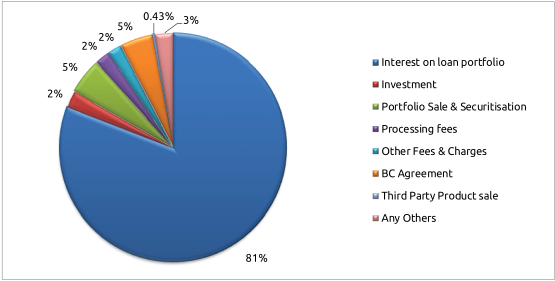
There is a significant connection between microfinance, agriculture and climate change. With climate change impacting the household, microbusiness, and systemic levels, its direct impact can be felt on their livelihood and income-generating capability. The data from MLIs indicates that over 65% of microloans are used for agriculture and allied activities. The ever-increasing climate change-related stress that impacts the repayment capabilities of the borrowers of the microloans, results in affecting the asset quality of the MLIs. Therefore, addressing climate adaptation is critical to ensuring the resilience and vibrancy of the microfinance industry. This close association of climate change-related stress affecting the income stability and indebtedness of the small and marginal farmers directly impacts their ability to repay loans which increases the portfolio risk for MLIs. The exhibit showing this connection between climate change, agriculture and microfinance is shown below.
Despite the tremendous benefits of the climate-smart agriculture technologies and the Government of India’s push for sustainable finance in agriculture, adoption of climate- smart agriculture technologies among smallholders is hindered by poor credit access, high costs, and risk perceptions. The uptake of CSA practice has been slow due to various financial and ecosystem barriers such as high investment requirements, higher bio-input cost, lack of de-risking mechanisms, lack of awareness, training and capacity building, etc.
6A.4 Opportunities for CSA Financing for MLIs
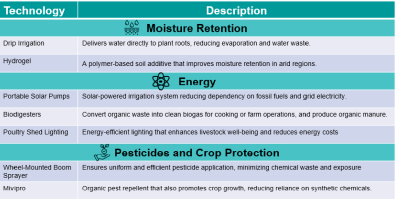
Globally, there are multiple examples of leveraging microfinance as a tool to promote climate adaptation through green energy products, concessional finance, financing climate-resilient technologies, training and capacity building. MLIs can enable farmers to adopt climate-resilient tools and technologies through financing CSA technologies tailored to their needs. The upfront costs of these technologies are much higher than what smallholder farmers can afford. By providing tailored financing solutions, MLIs can significantly promote adoption of these practices. Some of the prevalent CSA technologies that MLIs can promote for financing CSA adoption are presented in next page.
6A.5 Sa-Dhan’s Climate Resilient Agriculture Initiative
Sa-Dhan’s approach to promoting climate resilience is grounded in an evidence-based approach and focused on scaling proven solutions that have undergone rigorous field trials. To mitigate climate risks and enhance livelihoods, Microlending Institutions in India are empowering small and marginal farmers through financial support and awareness generation. Sa-Dhan in collaboration with GIZ India and Sustain Plus Energy Foundation is undertaking one such initiative “Expanding the reach of climate resilient technologies for agriculture through improved financial access” in India. The Impact of the project highlighting the critical role MLIs can play in climate adaptation is depicted below.
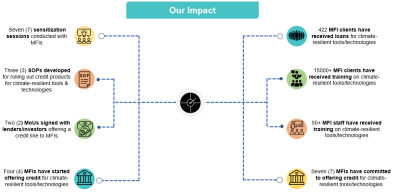
Key outcomes at the farmers’ level are: 1) Increased productivity; 2) Improved resilience to climate change-induced patterns such as erratic rainfall, pest attacks, etc, 3) Adoption of climate-resilient agricultural practices and 4) Cost Savings and increase in income. These outcomes not only contribute to climate adaptation but also directly support the economic empowerment goals of transforming smallholder farmers into Lakhpati (prosperous) farmers.
6A.6 Benefits for MLIs by Financing CSA Technologies
By financing CSA solutions, MLIs can not only contribute to a greener future by supporting sustainable agriculture practices but also result in a more resilient and better- performing agricultural portfolio. MLIs can help farmers become more resilient to climate change, leading to improved yields, reduced input costs, and greater access to markets. This, in turn, strengthens the financial health of both farmers and the MLIs that serve them. Some specific benefits for MLIs include,
Increased Profitability: Adopting CSA practice can lead to higher and more stable yields for farmers, reducing the risk of crop failure due to climate shocks. This will not only lead to increased income for MLIs borrowers - smallholder farmers and SMEs but also improve repayment rates for MLIs
Improved Portfolio Quality: By diversifying crops and adopting water-efficient techniques, farmers can better withstand droughts, floods, and other climate-related challenges. This reduces the risk of loan defaults for the MLIs as borrowers will be better immune to lower income due to crop loss.
Increased Client Outreach and Portfolio: Financing CSA allows MLIs to expand their client base by extending credit to agricultural borrowers and thus increasing their portfolio stability by diversifying exposure to traditional loans. This can lead to increasing client outreach and portfolio.
Carbon Credit Benefits: Financing CSA technologies allows MLIs a significant economic incentive by transacting verified and certified carbon reductions in carbon credit market. Regulated carbon credit programs typically involve substantial investments in technology and infrastructure leading to carbon footprint reductions and depending on the Voluntary Carbon Market (VCM) model the carbon credit sales income can be accrued to the MLIs.
Attract ESG-Focussed Investors: MLIs that issue ESG or sustainability-linked instruments and integrate ESG principles into their operation’s present attractive investment opportunities for ESG-focused investors. These institutions often exhibit strong governance practices, prioritize environmental sustainability, and target marginalized communities. Microfinance itself provides access to financial services to low-income individuals and small businesses. Hence, MLIs assimilating ESG framework as a part of business goals would be better placed to secure these funding sources.
Opportunities to Avail Grants and Corporate Social Responsibility (CSR) from Donors: MLIs that finance CSA technologies have significant opportunities to access grants and CSR funding from donors and socially responsible corporations.
6A.7 Learnings and Emerging Opportunities
The convergence of climate finance and microfinance presents a transformative opportunity to empower India’s rural communities while contributing to climate adaptation and mitigation. MLIs’ grassroots presence, financial inclusion focus, and trusted relationships with rural communities make them ideal intermediaries for delivering climate-resilient solutions at scale. Sa-Dhan’s learning from the current collaboration falls into two broad categories: 1) What MLIs can offer additionally, and 2) Opportunities for strengthening the Supply Side.
6A.7.1 What MLIs can offer additionally?
Green Loans: Expanding access to customised credit products for purchasing climate- resilient tools such as solar irrigation pumps, drip irrigation systems, bio-digesters, and weather-resilient seeds.
Bundled Solutions: Combining loans with access to clean technologies, training, and after-sales services to drive adoption and impact. Maintenance and reverse logistics were identified as key issues hindering the wider uptake of the products.
Risk Mitigation Tools: Facilitating access to micro-insurance products that protect against crop failure, livestock loss, or climate shocks.
Parametric Insurance Solutions: Enable coverage for otherwise difficult-to-insure risks. Facilitating swift claim settlements and accelerated financial support.
Climate Literacy and Advisory: MLIs can offer weather-based advisory services and promote sustainable farming practices by partnering with Agri-tech or climate advisory platforms.
6A.7.2 Opportunities for strengthening the Supply Side
Catalytic Capital: Philanthropic or public funding is critical to de-risk private investments into MLI-led green portfolios.
Green Credit Lines: Development finance institutions (DFIs) can establish low-interest climate credit lines that MLIs can on-lend to end-users.
Results-Based Financing (RBF): Governments and donors can offer incentives for MLIs based on climate outcomes achieved, such as energy saved or emissions avoided.
Blended Finance: Use of development finance and philanthropic funds to attract private capital to foster Public Private Partnerships to bolster sustainable finance market.
The portfolio is risky due to natural calamities, there is a need to showcase about the protection of portfolio. To do so certain option could be Credit Guarantee or First loan Guarantee, Interest Subvention, Subsidized funds/Products/Technologies can be explored to gain MLIs confidence.