


Chapter 6 - Section 6.1Micro Insurance
Insurance is intended to protect from unforeseen eventualities causing unexpected losses. Insurance, being a critical component of the basket of financial services, plays a significant role in India’s economy. The low- income and vulnerable individuals need them more than anyone as any small losses can affect them significantly. Hence, the concept of micro insurance or affordable insurance products, which can help manage and recover them from such losses. These products provide coverage for life, health and loss of assets.

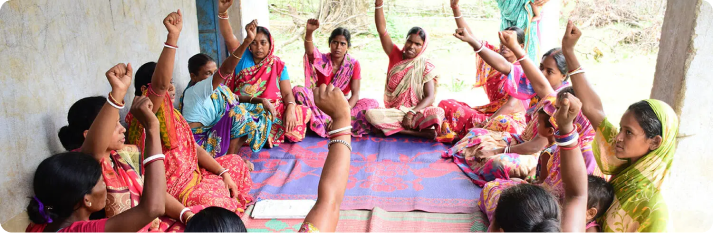
Beyond Microcredit - Evolving Role of Micro Lending Institutions (MLIs)
Microfinance and the Evolution of Credit-Plus Activities by MLIs
icrofinance is a social enterprise designed to benefit individuals at the bottom of the pyramid by enabling access to financial and support services aimed at improving their standard of living.
The earliest microfinance movements were hinged on the developmental and credit programmes which helped in an overall development of the poor families. It was understood by the proponders of microcredit programmes that credit alone was not sufficient to meet the diverse developmental needs of poor households. Hence, they adopted a strategy of going beyond micro-credit, to embracing a wide range of developmental and financial services. Even today many of the MLIs continue to follow the “Credit Plus” activities followed by the MLIs in the earlier days to a provide a comprehensive developmental package to the poor households. Many of these financial services and developmental programmes are tailored for low-income clients. These services include not only credit, but also savings, insurance, remittance, and money transfer services, among others.
Mainstream thinking increasingly supports the notion that poor households benefit more from an integrated package of services rather than credit alone. These institutions act as an alternative to banks for extending financial support directly to the underserved groups. Access to financial services, particularly for credit delivery and last-mile service, strengthens the Government of India (GoI) financial inclusion agenda. Financial inclusion enables investment in quality education and promotes entrepreneurial activity, leading to economic growth. In fact, a recent study 1 by IIT Madras and University of Connecticut has found that financial inclusion significantly improves chances of achieving Sustainable Development Goals (SDGs). G20 Global Partnership for Financial Inclusion (GPFI) identifies financial inclusion as a key enabler for at least 7 out of 17 SDGs. MLIs can combine the reach of the bank with SDGs through their credit plus activities.
Most of these microlending institutions continue to engage in developmental activities, beyond their credit role. The credit- plus activities of MLIs cover two dimensions: business development support (management and vocational training, marketing, technical assistance, product design, legal aid) and social interventions (literacy, education, health). Many also partner with financial institutions to offer savings, insurance, pensions, and social security. On the credit side, several MLIs have evolved beyond a plain vanilla credit product and have diversified into credit products for renewable energy, water and sanitation, health, and affordable housing etc.
This chapter highlights the credit-plus initiatives and diversified financial services offered by Micro Lending Institutions (MLIs).
1Impact of fintech and financial inclusion on sustainable development goals: Evidence from cross country analysis (https://doi. org/10.1016/j.frl.2024.106573)
6.1 Micro Insurance
Insurance is intended to protect from unforeseen eventualities causing unexpected losses. Insurance, being a critical component of the basket of financial services, plays a significant role in India’s economy. The low- income and vulnerable individuals need them more than anyone as any small losses can affect them significantly. Hence, the concept of micro insurance or affordable insurance products, which can help manage and recover them from such losses. These products provide coverage for life, health and loss of assets.
Apart from protection against mortality, property and casualty risks, it serves as a safety net for individuals and enterprises in urban and rural areas, from unexpected financial hardships. Insurance Regulatory Development Authority of India (IRDAI) serves as the principal regulatory body overseeing the insurance sector in India. It is an autonomous and statutory body under the jurisdiction of the Ministry of Finance, Government of India. As part of the regulatory role, IRDAI aims to insure all of India by 2047, where every citizen has an appropriate life, health and property insurance cover and every enterprise is supported by appropriate insurance solutions. Flagship government schemes such as the Pradhan Mantri Jeevan Jyoti Bima Yojana (PMJJBY), Pradhan Mantri Suraksha Bima Yojana (PMSBY), and Ayushman Bharat are also made accessible to clients by microinsurance institutions, in collaboration with insurance companies.
In order to facilitate penetration of insurance for underprivileged section of the society, the IRDAI has formulated the Micro Insurance Regulations, 2005, to provide micro insurance to the poor. The main thrust of micro insurance regulations is to protect low-income people with affordable insurance products. At first, IRDAI permitted only NGOs and Self-Help Groups to work as insurance intermediaries. After the 2015 regulation change, more organizations and individuals, including Micro Lending Institutions, were allowed to become Micro Insurance Agents. MLIs are mostly involved in extending health insurance cover.
According to information received from microfinance institutions, at least 37 MLIs are offering non-loan protection life insurance products. All MLIs continue to provide credit- linked life insurance to their borrowers, and in many cases, co-obligants are also covered. However, such coverage is typically restricted to the sanctioned loan amount and its tenure.
Data reported by MLIs indicates that around 105.43 lakh lives have been insured under life insurance schemes facilitated through MLIs. In addition, approximately 20.09 lakh individuals have been covered under general health insurance by 17 MLIs, while about 0.20 lakh have been covered under other non- health insurance products by 4 MLIs. For these services, MLIs collaborate with mainstream insurance companies. Institution-wise details of insurance coverage during the past year are presented in Tables 6.1, 6.2, and 6.3.
Table 6.1: MLIs involved in extending Life Insurance (in addition to credit-linked insurance)
| S.No. | Name of the MLI | Legal Form | No. of Clients |
|---|---|---|---|
| 1 | Agora Microfinance India Ltd. | NBFC-MFI | 24,846 |
| 2 | Ajagar Finance Pvt. Ltd. | NBFC-MFI | 4 |
| 3 | Annapurna Finance Pvt. Ltd. | NBFC-MFI | 16,11,584 |
| 4 | Annapurna Mahila Coop Credit Society Ltd. | MACS/Cooperative | 780 |
| 5 | Apaaresva Foundation | Sec. 8 Com. | 1,120 |
| 6 | Arohan Financial Services Ltd. | NBFC-MFI | 16,19,024 |
| 7 | BWDA Finance Ltd. | NBFC-MFI | 76,035 |
| 8 | Chaitanya India Fin Credit Pvt. Ltd. | NBFC-MFI | 12,44,922 |
| 9 | CreditAccess Grameen Ltd. | NBFC-MFI | 49,85,756 |
| 10 | Fingel Management Services Pvt. Ltd. | Pvt. Ltd. Com. | 1,697 |
| 11 | Friends Capital Services Ltd. (FCSL) | NBFC | 21,766 |
| 12 | Gramalaya Microfin Foundation (GMF) | Sec. 8 Com. | 11,437 |
| 13 | Grameen Shakti Microfinance Services Pvt. Ltd. | NBFC-MFI | 6,380 |
| 14 | Jeevan Utthan Financial Services Pvt. Ltd. | NBFC | 8,294 |
| 15 | Kamal Fincap Pvt. Ltd. | Pvt. Ltd. Com. | 1,30,250 |
| 16 | M Power Micro Finance Pvt. Ltd. | NBFC-MFI | 24,250 |
| 17 | Magalir Micro Capital Pvt. Ltd. | NBFC-MFI | 22,977 |
| 18 | Mahasemam Trust | Trust | 78,741 |
| 19 | PAFT Finance Ltd. | NBFC | 10,975 |
| 20 | PAFT Inclusive Financial Services Pvt. Ltd. | Pvt. Ltd. Com. | 4,874 |
| 21 | Palli Pragoti Financial Services Pvt. Ltd. | NBFC | 8,557 |
| 22 | Pragati Finserv Pvt. Ltd. | Pvt. Ltd. Com. | 1,40,529 |
| 23 | Pratyahna Financial Services Ltd. | NBFC | 8,424 |
| 24 | Rashtriya Seva Samithi (RASS) | Society | 99,814 |
| 25 | RORS Finance Pvt. Ltd. | NBFC-MFI | 11,370 |
| 26 | Samhita Community Development Services | Sec. 8 Com. | 29,570 |
| 27 | Sampada Entrepreneurship & Livelihoods Foundation (SELF) | Sec. 8 Com. | 6,938 |
| 28 | Sarwadi Finance Pvt. Ltd. | NBFC-MFI | 9,596 |
| 29 | Save Financial Managements Pvt. Ltd. | Pvt. Ltd. Com. | 57,790 |
| 30 | Shree Marikamba Micro Finance Pvt. Ltd. | NBFC-MFI | 4,850 |
| 31 | Shroff Capital and Finance Pvt. Ltd. | NBFC-MFI | 75 |
| 32 | Sindhuja Microcredit Pvt. Ltd. | NBFC-MFI | 1,05,716 |
| 33 | Socio Economic Action Trust | Trust | 3,068 |
| 34 | Sugmya Finance Pvt. Ltd. | NBFC | 42,164 |
| 35 | Svasti Microfinance Pvt. Ltd. | NBFC-MFI | 92,844 |
| 36 | Swayamshree Mahila Samabaya Ltd. | MACS/Co-operative | 20,672 |
| 37 | UNACCO Financial Services Pvt. Ltd. | NBFC-MFI | 15,433 |
Note: The list of MLIs offering these services is not exhaustive
Table 6.2: MLIs involved in Micro Insurance General Health
| S.No. | Name of the MLI | Legal Form | No. of Clients |
|---|---|---|---|
| 1 | Agora Microfinance India Ltd. | NBFC-MFI | 24,846 |
| 2 | Annapurna Mahila Coop Credit Society Ltd. | MACS/Cooperative | 11,347 |
| 3 | Arohan Financial Services Ltd. | NBFC-MFI | 14,13,723 |
| 4 | CreditAccess Grameen Ltd. | NBFC-MFI | 1,86,469 |
| 5 | Fingel Management Services Pvt. Ltd. | Pvt. Ltd. Com. | 2,269 |
| 6 | Friends Capital Services Ltd. (FCSL) | NBFC | 16,788 |
| 7 | Grameen Shakti Microfinance Services Pvt. Ltd. | NBFC-MFI | 11,125 |
| 8 | Jeevan Utthan Financial Services Pvt. Ltd. | NBFC | 7,753 |
| 9 | M Power Micro Finance Pvt. Ltd. | NBFC-MFI | 24,250 |
| 10 | Magalir Micro Capital Pvt. Ltd. | NBFC-MFI | 22,977 |
| 11 | PAFT Finance Ltd. | NBFC | 9,128 |
| 12 | PAFT Inclusive Financial Services Pvt. Ltd. | Pvt. Ltd. Com. | 4,654 |
| 13 | Pragati Finserv Pvt. Ltd. | Pvt. Ltd. Com. | 1,17,291 |
| 14 | Shroff Capital and Finance Pvt. Ltd. | NBFC-MFI | 40 |
| 15 | Sindhuja Microcredit Pvt. Ltd. | NBFC-MFI | 67,748 |
| 16 | Sugmya Finance Pvt. Ltd. | NBFC | 13,788 |
| 17 | Svasti Microfinance Pvt. Ltd. | NBFC-MFI | 75,010 |
Note: The list of MLIs offering these services is not exhaustive
Table 6.3: MLIs involved in Micro Insurance General - Non-health
| S.No. | Name of the MLI | Legal Form | No. of Clients |
|---|---|---|---|
| 1 | Annapurna Mahila Coop Credit Society Ltd. | MACS/Cooperative | 71 |
| 2 | Arohan Financial Services Ltd. | NBFC-MFI | 17,841 |
| 3 | Nanayusurabhi Development Financial Services (NDFS) | Sec. 8 Com. | 1,938 |
| 4 | Sugmya Finance Pvt. Ltd. | NBFC | 115 |
Note: The list of MLIs offering these services is not exhaustive