


Chapter 3 - Section 3.1Geographical Spread of Microfinance
The data collected from 203 MLIs indicate that microfinance has a presence in the majority of the districts, although in varying levels. It is hugely skewed towards the top 200 districts. The data on the portfolio1 from 203 MLIs, show that they collectively accounted for over 98% of the total MLIs portfolio, and covered across 28 states, 5 Union Territories, and 685 2 districts in India. Notably, this dataset diverges slightly from the figures presented in Chapter 2, which rely on information sourced from Credit Information Company (CIC) and indicate micro-lenders activities in 36 States/ UTs and over 750 districts. The observed variation is likely attributable to the inclusion of certain Business Correspondent (BC) partners acting on behalf of Banks and Financial Institutions, who may have been counted as extending operations in areas reported under the wider CIC-sourced dataset. Also, some of the districts where the operations existed earlier at some levels may not be active now. This methodological difference in reporting explains the discrepancies between the two geographic coverage assessments while affirming the extensive national footprint of MLIs.

India Country
Loan Amount Disbursed (in ₹ Cr.) of all micro-lenders across States/UTs during FY 2024-25 and FY 2023-24 (in descending order of Loan Amount Disbursed)
March 2023 742Lakh Unique Active Borrowers in Total
March 2024 867 Lakh Unique Active Borrowers in Total
3.1 Geographical Spread of Microfinance
The data collected from 203 MLIs indicate that microfinance has a presence in the majority of the districts, although in varying levels. It is hugely skewed towards the top 200 districts. The data on the portfolio1 from 203 MLIs, show that they collectively accounted for over 98% of the total MLIs portfolio, and covered across 28 states, 5 Union Territories, and 6852 districts in India. Notably, this dataset diverges slightly from the figures presented in Chapter 2, which rely on information sourced from Credit Information Company (CIC) and indicate micro-lenders activities in 36 States/ UTs and over 750 districts. The observed variation is likely attributable to the inclusion of certain Business Correspondent (BC) partners acting on behalf of Banks and Financial Institutions, who may have been counted as extending operations in areas reported under the wider CIC-sourced dataset. Also, some of the districts where the operations existed earlier at some levels may not be active now. This methodological difference in reporting explains the discrepancies between the two geographic coverage assessments while affirming the extensive national footprint of MLIs.
1 Portfolio, GLP, and Loan Outstanding have been used interchangeably throughout this report.
2 Some of these districts may not have an active presence of MLIs at present, as they may have exited. But they have been able to reach these districts at one time or another.
Table 3.1 provides a detailed breakdown of the number of MLIs operating across individual and multiple States or Union Territories, along with a comparative overview of the previous year’s distribution. This tabular representation enables a comprehensive understanding of operational expansion or contraction within the industry. Further, Annexure 1 presents a State and UT-wise mapping of various MLIs, Banks, and Small Finance Banks, illustrating their geographical presence across India while highlighting institutional outreach and market coverage.
An in-depth analysis reveals that during FY 2024-25, 31 MLIs operated in more than ten States or Union Territories, with 18 of these extending their operations across more than fifteen States/UTs. In contrast, 78 MLIs conducted their operations within a single State or UT, a slight decrease from 89 in the last year. Additionally, 94 MLIs functioned across 2 to 10 States/UTs. Detailed information on the geographical distribution of MLI operations across States and Union Territories is provided in Table 3.1.
Table 3.1: No. of Indian States/UTs covered by MLIs
| No. of States/UTs operated | No. of MLIs | |
|---|---|---|
| FY 2024-25 | FY 2023-24 | |
| 1 | 78 | 89 |
| 2 to 5 | 71 | 75 |
| 6 to 10 | 23 | 28 |
| 11 to 15 | 13 | 5 |
| > 15 | 18 | 20 |
| Total | 203 | 217 |
The number of States and Union Territories where Micro Lending Institutions (MLIs) operate has remained largely stable over the past two years, with minor variations in certain categories. Notably, there was a significant increase in the number of Micro Lending Institutions (MLIs) operating in 11 to 15 states, increasing from 5 MLIs in FY 2023-24 to 13 MLIs in FY 2024-25.
The larger MLIs, predominantly NBFC-MFIs, have expanded their geographic footprint across more States and UTs. In contrast, smaller MLIs, particularly those classified as “Not for Profit,” continue to focus their operations within one or two states, maintaining a regional concentration in their lending activities.
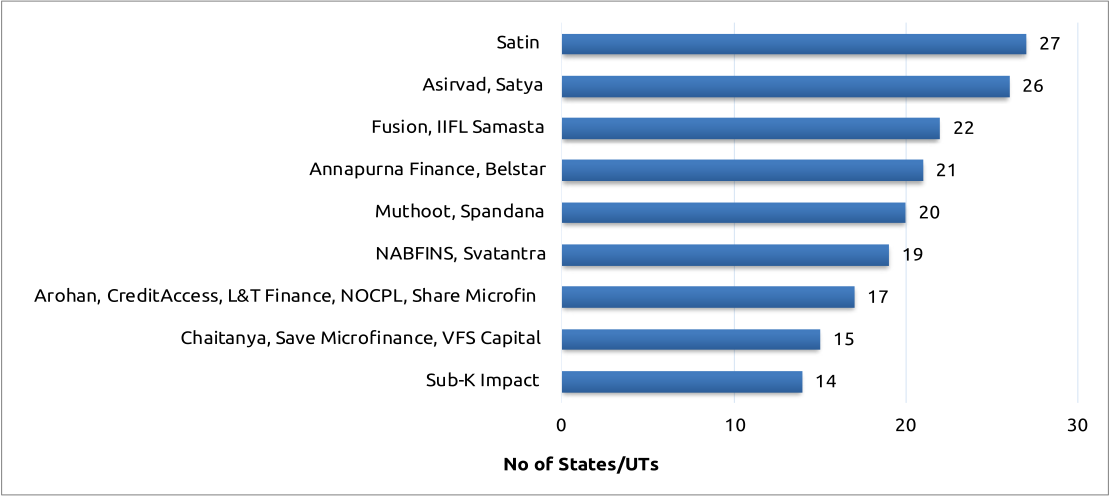
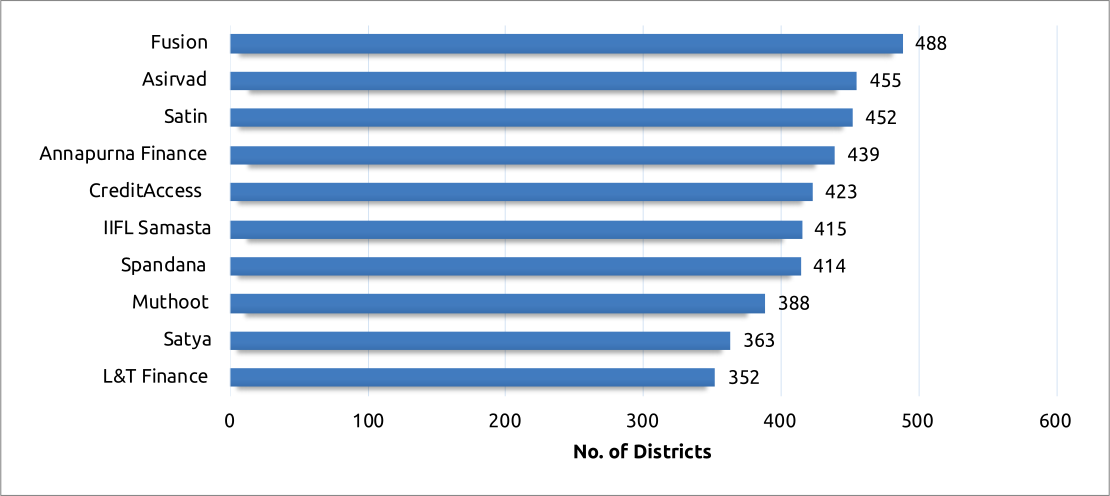
Figure 3.1 and Figure 3.2 depicts the top 10 MLIs based on their operations across States/ Union Territories and districts, respectively. Figure 3.1 depicts that Satin led with operations in 27 States/UTs, the highest among all MLIs. Following closely were Asirvad and Satya, each operating in 26 States/UTs, while Fusion and IIFL Samasta are operating in 22 States/ UTs.
Figure 3.1: Top 10 MLIs Operating in Number of Indian States/Union Territories as of March 2025
*Note: Avanti Finance has a presence in 26 States/UTs, respectively. But it works on a hybrid model (mainly tied up with Loan Service Providers/ BCs and some physical branches), to deliver different loan products to the clients across the country.
37 Figure 3.2: Top 10 MLIs Operating in Number of Indian Districts as of March 2025
*Note: Avanti Finance has a presence in 26 States/UTs, respectively. But it works on a hybrid model (mainly tied up with Loan Service Providers/ BCs and some physical branches), to deliver different loan products to the clients across the country.
Figures 3.1 and 3.2 indicate that Satin (27 states/UTs) is leading in terms of its presence in States/UTs, while Fusion (488 districts) is leading in terms of the number of districts.
Operation of MLIs in States/UTs
Table 3.2 indicates that Bihar has the highest branch network among MLIs, with 71 institutions operating a total of 4,932 branches. This was followed closely by Uttar Pradesh, which had 4,806 branches, and Tamil Nadu with 4,296 branches, respectively.
Table 3.2: No. of MLIs operating in Indian States/UTs districts as of March 2025, with the number of branches (in alphabetical order)
| Name of the State/UT | No. of MLIs operating in the State (including those having Headquarters outside) | No. of districts of the state where MLIs operate | No. of Branches |
|---|---|---|---|
| Andaman & Nicobar Islands | 2 | 1 | 4 |
| Andhra Pradesh | 26 | 25 | 527 |
| Arunachal Pradesh | 6 | 7 | 16 |
| Assam | 27 | 33 | 585 |
| Bihar | 71 | 38 | 4,932 |
| Chandigarh | 2 | 1 | 2 |
| Chhattisgarh | 41 | 30 | 906 |
| Delhi | 12 | 9 | 23 |
| Goa | 12 | 2 | 32 |
| Gujarat | 39 | 31 | 1,346 |
| Haryana | 45 | 22 | 823 |
| Himachal Pradesh | 13 | 10 | 52 |
| Jammu & Kashmir | 5 | 4 | 13 |
| Jharkhand | 45 | 24 | 1,159 |
| Karnataka | 47 | 31 | 3,362 |
| Kerala | 41 | 14 | 910 |
| Madhya Pradesh | 66 | 54 | 2,716 |
| Maharashtra | 55 | 36 | 2,271 |
| Manipur | 10 | 13 | 50 |
| Meghalaya | 9 | 5 | 14 |
| Mizoram | 5 | 4 | 13 |
| Nagaland | 3 | 3 | 8 |
| Odisha | 48 | 30 | 2,265 |
| Puducherry | 28 | 4 | 63 |
| Punjab | 23 | 23 | 584 |
| Rajasthan | 56 | 41 | 1,966 |
| Sikkim | 6 | 4 | 18 |
| Tamil Nadu | 74 | 38 | 4,296 |
| Telangana | 26 | 33 | 515 |
| Tripura | 17 | 8 | 194 |
| Uttar Pradesh | 73 | 74 | 4,806 |
| Uttarakhand | 32 | 10 | 250 |
| West Bengal | 50 | 23 | 2,658 |
| 685 | 37,380 |