


Chapter 2 - Section 2.3 - SubSection 2.3.3State/UT-wise Loan Outstanding per Unique Active Borrowers (in `)
Table 2.5 provides data on loan outstanding per unique active borrowers across States and Union Territories, showing an overall year-onyear decrease of 10%. This decline is largely attributable to a more cautious and risklimiting stance adopted by micro-lenders in response to rising delinquencies and increased borrower leverage. Additional contributing factors include regulatory measures imposed by self-regulatory organizations, such as restrictions on the number of micro-lenders and caps on combined microfinance and retail (unsecured) loan exposure for households, which is not to exceed `2 lakhs.

India Country
Loan Outstanding per Unique Active Borrowers across States/UTs (in ₹) - March 2025 and March 2024 (in descending order of Loan Outstanding per Unique Active Borrowers)
March 2023 742Lakh Unique Active Borrowers in Total
March 2024 867 Lakh Unique Active Borrowers in Total
2.3.3 State/UT-wise Loan Outstanding per Unique Active Borrowers (in ₹)
Table 2.5 provides data on loan outstanding per unique active borrowers across States and Union Territories, showing an overall year-on-year decrease of 10%. This decline is largely attributable to a more cautious and risklimiting stance adopted by micro-lenders in response to rising delinquencies and increased borrower leverage. Additional contributing factors include regulatory measures imposed by self-regulatory organizations, such as restrictions on the number of micro-lenders and caps on combined microfinance and retail (unsecured) loan exposure for households, which is not to exceed ₹2 lakhs.
Table 2.5 Loan Outstanding per Unique Active Borrowers across States/UTs (in ₹) - March 2025 and March 2024 (in descending order of Loan Outstanding per Unique Active Borrowers)
| S. No | State/UT | March 2025 (in ₹) |
March 2024 (in ₹) |
Y-o-Y Growth (in %) |
|---|---|---|---|---|
| 1 | Karnataka | 56,362 | 64,925 | -13% |
| 2 | Puducherry | 55,327 | 65,511 | -16% |
| 3 | Tamil Nadu | 54,776 | 62,807 | -13% |
| 4 | Bihar | 51,136 | 59,885 | -15% |
| 5 | Kerala | 50,968 | 63,826 | -20% |
| 6 | West Bengal | 47,973 | 52,251 | -8% |
| 7 | Goa | 47,633 | 54,891 | -13% |
| 8 | Tripura | 47,511 | 50,321 | -6% |
| 9 | Maharashtra | 47,091 | 50,897 | -7% |
| 10 | Jharkhand | 46,446 | 53,636 | -13% |
| 11 | Arunachal Pradesh | 45,962 | 41,109 | 12% |
| 12 | Odisha | 45,956 | 55,495 | -17% |
| 13 | Dadra and Nagar Haveli | 45,316 | 78,249 | -42% |
| 14 | Uttar Pradesh | 44,949 | 50,674 | -11% |
| 15 | Jammu & Kashmir | 43,378 | 45,016 | -4% |
| 16 | Daman and Diu | 43,199 | 1,25,812 | -66% |
| 17 | Uttarakhand | 42,798 | 48,560 | -12% |
| 18 | Chhattisgarh | 42,695 | 45,277 | -6% |
| 19 | Haryana | 42,375 | 47,611 | -11% |
| 20 | Madhya Pradesh | 42,239 | 46,344 | -9% |
| 21 | Nagaland | 42,152 | 39,504 | 7% |
| 22 | Rajasthan | 41,364 | 47,192 | -12% |
| 23 | Gujarat | 40,747 | 47,948 | -15% |
| 24 | Sikkim | 40,624 | 41,890 | -3% |
| 25 | Himachal Pradesh | 39,867 | 43,301 | -8% |
| 26 | Andaman and Nicobar Islands | 39,006 | 41,657 | -6% |
| 27 | Punjab | 38,568 | 42,901 | -10% |
| 28 | Chandigarh | 36,618 | 39,493 | -7% |
| 29 | Delhi | 35,139 | 39,346 | -11% |
| 30 | Assam | 33,844 | 37,602 | -10% |
| 31 | Lakshadweep | 32,741 | 53,477 | -39% |
| 32 | Meghalaya | 31,852 | 31,454 | 1% |
| 33 | Mizoram | 30,455 | 32,032 | -5% |
| 34 | Telangana | 27,165 | 17,378 | 56% |
| 35 | Manipur | 22,988 | 24,798 | -7% |
| 36 | Andhra Pradesh | 22,176 | 18,002 | 23% |
| 37 | Others | 21,303 | 35,207 | -39% |
| Industry | 46,064 | 51,051 | -10% | |
On a year-on-year comparison, 31 States and Union Territories recorded a decline in loan outstanding per borrower, with the exception of five states with relatively limited microfinance market presence i.e., Telangana (56%), Andhra Pradesh (23%), Arunachal Pradesh (12%), Nagaland (7%), and Meghalaya (1%)—which experienced increases. In contrast, key states with substantial loan outstanding, such as Bihar (-15%), Tamil Nadu and Karnataka (-13% each), Uttar Pradesh (-11%), and West Bengal (-8%), witnessed notable declines in loan outstanding per borrower
Table 2.6 Distribution of industry loan outstanding (in ₹ Cr.) across active lenders and borrowers’ credit exposure as of March 2025
The following table depicts the distribution of loan outstanding (in ₹ Cr.) across different numbers of active lenders and borrowers’ credit exposure:
| Active Lenders/ Borrower Credit Exposure | < ₹1 Lakh | ₹1 Lakh–₹1.25 Lakh | ₹1.25 Lakh–₹1.5 Lakh | ₹1.5 Lakh+ |
|---|---|---|---|---|
| < 2 lenders | 2,31,500 | 26,083 | 12,065 | 9,139 |
| 3 lenders | 21,399 | 13,233 | 10,134 | 11,303 |
| 4 lenders | 6,136 | 6,041 | 6,095 | 9,470 |
| 5 lenders | 1,807 | 2,639 | 3,463 | 10,718 |
It can be observed from Table 2.6 above that the majority of the industry loan outstanding, i.e., 61% is concentrated within the bucket of less than 2 active micro-lenders and having a credit exposure of less than ₹1 lakh. The guardrails introduced by the SROs, such as capping the number of micro-lenders at 3 micro-lenders, the total credit exposure of a borrower at ₹2 lakhs, among others, and complemented by the RBI regulations, forms part of a broader framework aimed at ensuring responsible lending, strengthening borrower protection etc. which have limited the borrowers’ credit exposure, thereby reducing risk and contributing to more sustainable microfinance operations.
Figure 2.5: Regional distribution of Loan Outstanding (in %)
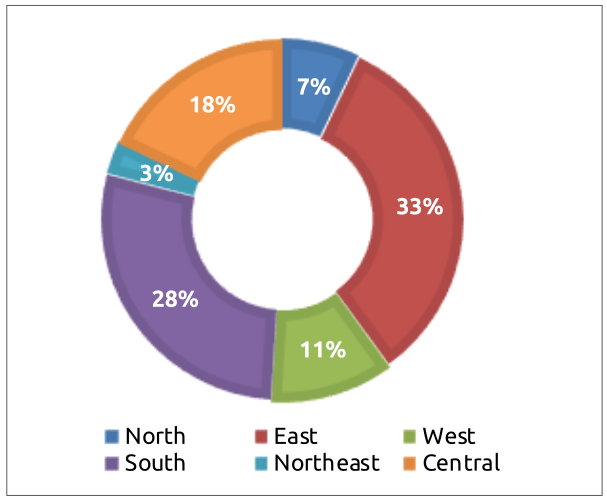
In terms of regional distribution of loan outstanding, the Eastern region—comprising Bihar, Odisha, Jharkhand, West Bengal, and Andaman & Nicobar Islands—led with a 33% market share. This was followed by the Southern region, which includes Andhra Pradesh, Karnataka, Kerala, Tamil Nadu, Telangana, Puducherry, and Lakshadweep, accounting for 28%. The Central region, consisting of Madhya Pradesh, Uttar Pradesh, Chhattisgarh, and Uttarakhand, held 18% of the market share. The Western region, covering Gujarat, Maharashtra, Goa, and Dadra & Nagar Haveli and Daman & Diu, contributed 11%, while the Northern region— encompassing Delhi, Haryana, Rajasthan, Punjab, Chandigarh, Himachal Pradesh, Jammu & Kashmir, and Ladakh—accounted for 7%. The Northeastern states, including Assam, Manipur, Tripura, Nagaland, Sikkim, Meghalaya, Mizoram, and Arunachal Pradesh, had the smallest share at 3%.