


Chapter 1Inclusive Growth Through Resilient Microfinance
The global economy in 2025 presents a complex, sometimes confusing, but at the same time resilient to shocks in the system. The economies around the world are grappling with geopolitical and global trade tensions. In addition to these are climate disruptions, stagnation of demand for goods and inflationary pressures. According to the IMF, the global GDP in 2025 is expected to be in the range of 3.3%. The World Bank has echoed concerns about the medium-term growth prospects due to high interest rates, disruption in supply chain and deglobalization trends.

Inclusive Growth Through Resilient Microfinance Nanaiah Kalengada
1.1 Global Outlook
he global economy in 2025 presents a complex, sometimes confusing, but at the same time resilient to shocks in the system. The economies around the world are grappling with geopolitical and global trade tensions. In addition to these are climate disruptions, stagnation of demand for goods and inflationary pressures. According to the IMF, the global GDP in 2025 is expected to be in the range of 3.3%. The World Bank has echoed concerns about the medium-term growth prospects due to high interest rates, disruption in supply chain and deglobalization trends.
The significant shift has been the tariff announcement by the US in April’25, which introduced a blanket tariff and also additional country-specific levies. Along with geopolitical tension, this created confusion among investors and created uncertainties in commodity prices. In the midst of this, the Financial Stability Institute of the Bank for International Settlements has raised concerns about the adequacy of existing liquidity requirements with banks and the impact of climate change on reinsurance markets. In their May’25 report on “Rethinking banks’ Liquidity Requirements” FSI has suggested revisiting current frameworks to better address emerging risks.
The IMF, too, in its April 2025 Global Financial Stability report titled “Enhancing Resilience amid Uncertainty” identifies elevated asset valuations, high financial leverage and sovereign debt concerns as key global financial risks. Another factor that is shaping the global economic environment is the volatility in crude oil prices, which in the recent past has moved between $74 a barrel to $58.29 a barrel due to factors such as an increase in production by OPEC members and also a projected slowdown in global oil demand. However, the markets around the world at some point give an impression of having factored in these uncertainties and learnt to navigate through global tensions.
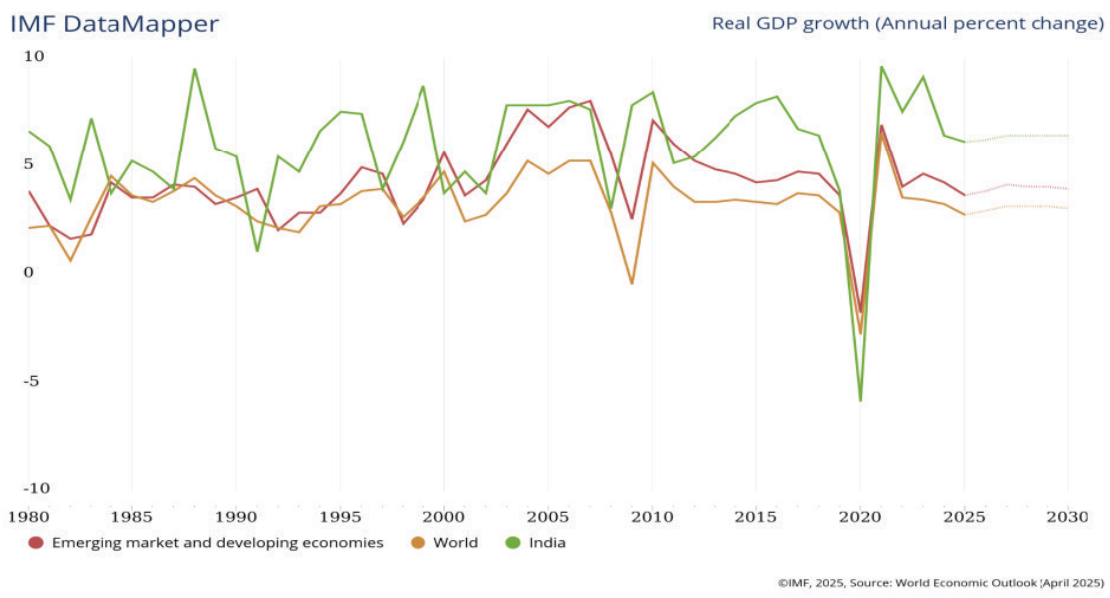
Despite turbulence in the global economy, India continues to post robust GDP growth, sustained by strong domestic demand—outpacing levels that many nations struggle to match. Amid global challenges, India has also seized opportunities such as benefiting from lower oil prices—especially significant given that the country imports nearly 80% of its crude oil requirements and positioning itself as an attractive base for global manufacturing.
1.2 Indian Economic Outlook through the lens of Rural India
India has moved to become the fourth largest economy in the world, with the GDP touching $4.19 trillion as per IMF’s World Economic Outlook 26th May, 2025. India has rebounded strongly post the pandemic and is projected to be the world’s fastest-growing major economy (6.3% to 6.8% in 2025-26). As per OECD, India’s growth rate is projected to be the highest among the G20 nations. The sustained growth is powered by the investments in public infrastructure, digital connectivity, private consumption and rural transformation initiatives by the government of India.
The rural economy contributes close to 46% of the country’s GDP, with over 65% of the population residing in rural India. A range of flagship programs launched by the Government of India are accelerating development and unlocking rural demand. For example improving road connectivity through Pradhan Mantri Gram Sadak Yojana, rural electricity via Deen Dayal Upadhyaya Gram Jyoti Yojana (DDUGJY), BharatNet Project for digital transformation, National Rural Health Mission (NRHM) for improving rural healthcare, Pradhan Mantri Awas Yojana-Gramin for providing housing to the economically weaker segment of the society and Mission Amrit Sarovar with an objective to conserve water for future.
- PMGSY has built over 7.8 lakh kilometers of roads, connecting remote villages to markets, schools, and healthcare services, enabling economic activity and access to social services.
- DDUGJY and Saubhagya Yojana have significantly expanded access to power in rural India. As per World Bank data, India has achieved 99.5% coverage on electrification.
- Ayushman Bharat is enhancing rural health coverage and laying the foundation for an integrated digital health ecosystem.
- BharatNet is a rural broadband project by the Indian government aimed at connecting all Gram Panchayats (GPs) with high-speed internet. As per the Ministry of Communication report dt 2nd Aug ‘24, 95.15% villages have access to internet with 3G/4G mobile connectivity, and as of March 2024, out of a total of 954.40 million Internet Subscribers in India, there are 398.35 million Rural Internet Subscribers, enabling digital service delivery seamlessly in rural India.
- MGNREGA, implemented by the Ministry of Rural Development, guarantees 100 days of wage employment in a financial year to every rural household whose adult members volunteer to perform unskilled manual work.
While government-led programs are playing a vital role in uplifting the rural economy, a deeper understanding of its evolving dynamics is essential. Factors such as demographic shifts due to migration, rising rural wages, and the increasing impact of climate change are reshaping rural livelihoods and economic opportunities.
Migration: Migration to urban areas continues to have a dual impact on the rural economy. On one hand, it might lead to a shortage of agricultural labour; on the other, it generates remittances that drive rural consumption. According to the Economic Survey 2023– 24, more than 40% of India’s population is projected to live in urban areas by 2030, based on NITI Aayog projections. The Periodic Labour Force Survey (PLFS) 2020–21 conducted by MoSPI reports that migration patterns include 18.9% rural-to-urban. Interstate migration remains concentrated, with Maharashtra, Gujarat, Delhi, Haryana, and West Bengal as key migrant-receiving states, while Uttar Pradesh, Bihar, Rajasthan, Madhya Pradesh, Uttarakhand, and Odisha are major sourcing states, as per the National Institute of Urban Affairs. The economic impact of remittances is also reflected in the growth of microfinance portfolios in states like Bihar & UP, where remittance flows are likely supporting borrower repayment capacity and credit demand.
Rural Wages: Rural wages have shown consistent growth in FY25. As per Labour Bureau data (April–September 2024), rural wages rose by over 4% year-on-year each month. Agricultural wages increased by 5.7% for men and 7% for women, while in non- agricultural sectors, the growth was 5.5% for men and 7.9% for women. This steady rise in earnings—particularly for women—is a positive signal for the microfinance sector, where over 95% of borrowers are women. Higher rural incomes directly support improved repayment behaviour and loan utilization.
Climate Impact: Climate variability remains a major risk to rural livelihoods, with erratic monsoons, floods, and rising temperatures dis-rupting agricultural productivity. Recognizing this, the Government of India has introduced schemes like the Pradhan Mantri Fasal Bima Yojana (PMFBY) and Agri Stack to improve climate resilience and support farmers. Time and again, adverse weather conditions have impacted microfinance loan performance. However, government-backed initiatives like PMFBY offer some financial protection to vul-nerable rural borrowers, including those ac-cessing microfinance.
Rural India remains a cornerstone of India’s economic growth. The Government of India’s sustained focus on rural development, through initiatives on infrastructure development, digital connectivity, healthcare, housing, and livelihood support, is steadily transforming the rural economy into a more robust and productive engine of growth. Internet penetration provides an opportunity to leverage tech to deliver financial services to rural India. These initiatives are not only enhancing the quality of life and economic participation of rural citizens but are also creating the opportunity for greater financial inclusion and positioning rural India as a key driver of inclusive national development.
1.3 Lending landscape: Microlending in India’s expanding retail lending space
India’s lending ecosystem has been transformed by digital innovation, progressive regulation and the availability of trusted data sources. Equally significant is the cultural shift in attitudes toward borrowing. Once viewed as a last resort—limited to emergencies or venturing into setting up large businesses — borrowing is now widely accepted as a means to achieve personal and professional goals. Small businesses that once depended solely on personal savings to start and operate are increasingly turning to formal credit to meet their working capital needs.
This cultural shift is evident in everyday decisions—for instance, a prospective car buyer today more often focuses on the capacity to make an initial down payment and monthly EMI, rather than the total cost of the vehicle to make the final decision. This evolving mindset, coupled with India’s demographic dividend and large aspirational middle class, is fueling strong and sustained demand for credit across the country. Banks, NBFCs, and the expanding fintech ecosystem are actively tapping into this opportunity, accelerating the formalization and penetration of credit.
Initially, the financial inclusion movement was led by microfinance institutions and self-help group initiatives, which focused on extending credit access to underserved populations in rural and semi-urban India. This bottom- up approach laid the foundation for India’s financial inclusion journey—starting in rural areas, gradually expanding to semi-urban, and, to a limited extent, urban regions.
Today, FinTech’s are contributing significantly to this journey as well, but from the opposite direction, beginning in urban centers and progressively expanding into semi-urban and rural markets. They are helping bring access to credit to underserved customer segments, including Gen Z and individuals with little to no formal credit history. By leveraging both traditional credit bureau data and alternative data sources—such as digital footprints, transaction patterns, and mobile usage— fintechs are reaching borrowers previously either excluded or deterred by the complexity of the formal lending ecosystem.
This convergence of traditional and new-age financial players is shaping a promising finan- cial inclusion story in India. Yet, much remains to be done. Expanding access to the “new-to- credit” segment will require broader adoption of frameworks like Account Aggregators (AA) and greater use of alternative data, including UPI and consumption behaviour, to build more inclusive and accurate credit assessments.
Retail credit in India has grown significantly over the last few years, and most importantly, the unsecured credit growth has been phenomenal. However, signs of moderation are emerging, according to the TransUnion CIBIL Credit Market Indicator (CMI) Report — June 2025. The report reveals important shifts in credit demand across urban, semi- urban, and rural regions, highlighting evolving consumption patterns and financial behaviour. In particular, rural India accounted for 22% of total credit enquiries in March’25, up from 20% in both March 2023 and March 2024. Semi-urban regions led the trend, with their share rising to 30% in March’25, compared to 29% in March’24 and 28% in March’23. Urban accounted for 19% of the credit enquiries as on March’25 compared to 20% in March’23 & March’24. Meanwhile, metro areas saw a decline, with their share of enquiries dropping from 32% in March ‘23 to 29% in March ‘25.
While it may be premature to call this a structural rural shift, these numbers signal a growing appetite for credit outside urban & metro centers. This aligns with themes discussed earlier, government interventions in rural infrastructure and financial inclusion initiatives, cultural shifts toward formal borrowing, and the availability of alternative and trusted data sources, all contributing to deeper credit penetration in the country and more specifically in non-urban areas.
While much of the discussion has focused on the surge in retail unsecured lending in India, microlending has grown in parallel, demonstrating its increasing importance in India’s credit landscape.
Pradhan Mantri Mudra Yojana (PMMY) launched in 2015, was designed to provide access to credit to non-corporate, non-formal micro and small enterprises across the country. Since its inception, the program has sanctioned over 52 crore loans amounting to approximately ₹32.6 lakh crore (as per PIB report,7th April’25), with women accounting for the majority of beneficiaries (68%). Most of these loans have been small-ticket ‘Shishu’ loans, fostering first-time entrepreneurship and supporting self-employment among underserved populations. MUDRA has laid the foundation for grassroots entrepreneurship in India.
Lakhpati Didi initiative launched in 2023 under the Deendayal Antyodaya Yojana—National Rural Livelihood Mission (DAY-NRLM), it focuses on empowering SHG members to transition into entrepreneurial ventures. By leveraging their inherent skills and potential, the program positions them to move into higher income brackets. This initiative has rapidly advanced financial empowerment for rural women across India. As of the PIB report dt 29th Aug’24, over one crore women have achieved ‘Lakhpati Didi’ status, meaning their annual income exceeds ₹1 lakh. The scheme is being implemented across 7,000 blocks in 742 districts.
Fintech’s in India played a significant role in personal loan growth, starting the journey around 2018. During FY24–25, as highlighted in the FACE Report (Apr 2018 – Mar 2025), of the 14 crore personal loan accounts sanctioned amounting to ₹8.8 lakh crore during the year, Fin- Tech NBFCs contributed 10.9 crore loans worth ₹1,06,548 crore. While their share was only 12% of the total sanction val- ue, fintech’s drove 74% of sanction volumes, under- scoring their impact on expanding access to credit. Importantly, 56% of the total loan value comprised tickets below ₹50,000, meeting the demand for small-ticket loans often overlooked by traditional banks. Borrower demographics further highlight in- clusivity: over two-thirds of sanction value went to borrowers under 35 years of age, and 16% was disbursed to women, reflecting both youth adoption and increasing female partici- pation. Together, these trends firmly establish fintech’s as key enablers of digital financial in- clusion in India.
Microfinance portfolio more than doubled from ₹1.87 lakh crore in 2019 to a peak of ₹4.15 lakh crore in 2024, before moderating slightly to ₹3.75 lakh crore as of March’25. In comparison, the personal loan portfolio stood at ₹14.81 lakh crore as on March ‘25, positioning microfinance at approximately 25% of the total unsecured personal loans segment. This growth is not only in value but also in outreach. Microfinance institutions now serve 6.72 crore borrowers as of March 2025, underscoring their vital role in extending credit to underserved and low-income households. Significantly, over 95% of these borrowers are women, highlighting the sector’s contribution to women’s financial empowerment and inclusive growth.
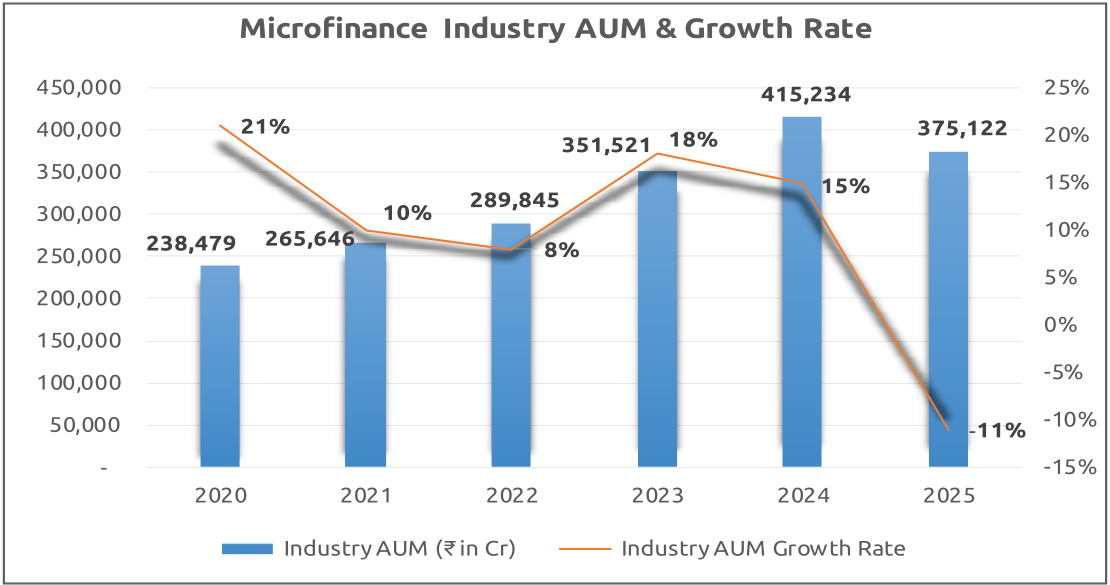
Together with the rapid expansion of government-backed schemes like PMMY and Lakhpati Didi, alongside the robust growth of the Fintech & Microfinance portfolio, highlights the critical role of microlending in driving inclusive growth in India.
1.4 Resilient Microfinance
The Self-Help Group (SHG) and microfinance movement began in the 1970s, led by early pioneers like SEWA (Self-Employed Women’s Association), and gained nationwide traction in the 1990s through NABARD’s SHG-Bank Linkage Programme launched in 1992. The microfinance industry in India has traversed a complex journey since its inception in the 1970s, facing multiple crises that have shaped its evolution.
In its early years, the sector grappled with issues of sustainability, weak repayment mechanisms, and limited scalability as NGO- led models struggled to formalize operations. The most significant crisis emerged in 2010 with the Andhra Pradesh microfinance crisis, which marked a turning point in the sector’s governance framework. This crisis prompted RBI to set up the Malegam Committee in 2011, which introduced tighter regulatory controls, including interest rate caps and borrower- level limits, forcing operational restructuring across MFIs.
The sector faced further disruption during demonetization in 2016, when its heavy reliance on cash-based collections led to a spike in defaults. This was followed by the COVID-19 pandemic in 2020–21, which brought a fresh set of challenges. Lockdowns halted field operations, borrower incomes declined, and delinquencies rose. Despite these headwinds, the industry remained largely stable through 2021 and 2022, avoiding collapse due to timely regulatory interventions, including a loan repayment moratorium initially for three months and later extended to six months.
The post-COVID recovery was strong, with the industry’s portfolio growing over 21%, from ₹2.89 lakh crore in 2022 to ₹3.51 lakh crore in 2023. This momentum continued into 2024, with the portfolio expanding by another 18%. However, in hindsight, this rapid growth also contributed to a build-up of borrower over- indebtedness. After about four quarters, the industry is beginning to show early signs of stabilization and recovery in portfolio quality. Despite these cyclical setbacks, the sector has consistently demonstrated resilience and the ability to rebound. Going forward, it will be key to the industry to internalize lessons from these cyclical movements and continue to transform to ensure sustainable, inclusive, and responsible growth.
Some of the key questions as we look at the microfinance model are:
- Does the Joint Liability Group (JLG) model
still hold relevance in today’s ecosystem?
The JLG (Joint Liability Group) model in microfinance was built on the principle of joint liability, where a group of individuals form a group to jointly guarantee each other’s loans. The group’s mutual guarantee acts as a form of social collateral; however, changing borrower behaviour, weakening peer pressure, and urban migration have reduced its effectiveness. In some markets, group discipline has eroded, and borrowers now have access to multiple lenders.
It is time to pivot from the traditional JLG model to a hybrid one that combines the concept of social collateral with individual accountability and leverages the rural con- nectivity & tech stack to reduce the high- touch model. Including real-time credit bureau checks to monitor portfolio, could be a classic use case of leveraging Chat GPT or AI tools for borrower assessments and early warning signals. Where appropriate, lenders could consider transitioning to in- dividual loans for borrowers with a strong repayment history. With the RBI’s revised norms on qualifying assets, such a model becomes a viable and strategic option for microfinance institutions aiming to evolve while maintaining their core inclusion mandate. - Is the high-touch, field-intensive model
scalable in a digital-led credit landscape?
The traditional MFI model is heavily reliant on manual processes, branch infrastructure, face-to-face interactions in group/centre meetings and paper- based systems, which limits the scalability and drives up costs. Meanwhile, fintech’s are scaling rapidly with lower customer acquisition costs.
MFIs need to adopt digital tools for on- boarding, credit appraisal, and collections. Partnerships with fintech’s or leveraging API-based infrastructure (like India Stack, OCEN) can help scale efficiently. Over time, shift lower-value interactions (e.g., reminders, service requests) to IVR & chat- bots while reserving field visits for critical customer engagement. A “phygital” mod- el—combining digital tools with field pres- ence, may be most effective in the near term. - Is the available data sufficient for robust risk
assessment and scalable underwriting?
One of the critical challenges facing the microfinance industry is the recency and depth of credit data, particularly in the case of low-income borrowers. Many of these individuals lack formal credit histories, income documentation, or a digital financial footprint. Additionally, smaller MFIs often operate with limited analytical capabilities, relying heavily on static borrower information provided by credit bureaus or qualitative assessments, which limits their ability to scale underwriting effectively and manage risk dynamically.
While the recent RBI mandate requiring regulated entities to submit data every 15 days and credit bureaus to update records within 7 days is a positive step toward improving data recency, it may still fall short in the context of low-ticket, high-velocity lending. Borrowers’ credit profiles can change materially in shorter timeframes. Therefore, the ecosystem must aim to transition toward daily data submission and updates to enhance the accuracy of risk assessment.
In addition to improving the recency of data in the credit bureaus, getting the SHG data in the credit bureaus would enhance the view of the borrower’s obligation and capacity to pay the loan EMI. Considering both microfinance and SHG are addressing or solving for access to credit to underserved populations, SHG data will strengthen the risk assessment by microfinance institutions. Collaboration with ecosystem enablers like Account Aggregators can also provide richer, real- time data to strengthen underwriting frameworks and improve financial inclusion outcomes. - Are employee attrition and lack of
continuity in customer relationships
undermining trust and retention?
High attrition among field staff, more specifically the loan officer, remains a persistent challenge in the microfinance sector, with attrition rates often hovering around 50%. This is possibly driven by a combination of factors, as field staff frequently operate in high-stress environments, face intense pressure to meet collection targets, limited career advancement opportunities and work within incentive structures that are heavily target-driven. In a high-touch business like microfinance, customer relationships are critical. Disruptions in staff continuity can significantly impact collections as well as opportunities for repeat business, such as cross-sell or upsell. Borrowers may feel disconnected or hesitant to engage with new or frequently changing field officers, and a lack of historical borrower context can lead to weaker field assessments and decision-making.
To address this, the industry must collectively implement a combination of interventions. Leveraging technology is key in terms of maintaining a digital trail of customer interactions that can ensure continuity even when staff change. Diversifying customer touchpoints within the organization—such as through helplines, apps, or dedicated service teams—can reduce over-reliance on the loan officer. Additionally, strengthening employee engagement, improving support systems, and shielding field staff as much as possible from external pressures in the market can help improve morale and retention. By enhancing workforce stability and digitizing customer engagement, the sector can build trust, improve customer retention, and deliver a consistent and high-quality borrower experience over time. - Despite policy and financial interventions,
does the bottom-of-the-pyramid segment
remain structurally vulnerable?
The poorest borrowers often rely on informal incomes with high volatility and lack of safety nets. Even small income shocks like health issues or crop failure can derail their repayment ability.
These questions merit closer examination as India’s microfinance story unfolds, without which the broader vision of inclusive, credit- led growth may remain unfulfilled.
1.5 Rails for the Next Wave of Inclusive Growth in Microfinance
From an ecosystem perspective, a multitude of government-led transformative initiatives are reshaping rural and semi-urban India, laying the foundation for robust and inclusive economic growth in these regions. These are enhancing public infrastructure, improving livelihoods, and enabling rural commerce thereby creating ground for sustainable economic development. Initiatives such as the PM Jan Dhan Yojana (PMJDY), Grameen Credit Score, Unified Lending Interface (ULI), and broader access to trusted digital data sources are laying the rails for the future of inclusive growth of micro credit.
- The Pradhan Mantri Jan Dhan Yojana
(PMJDY): The Pradhan Mantri Jan
Dhan Yojana (PMJDY), one of India’s
most transformative financial inclusion
initiatives, has opened 55.02 crore
accounts as of 7th March 2025, with 36.63
crore (as per PIB, 18th March 2025) in
rural and semi-urban areas, underscoring
its reach beyond urban centres. These
accounts have brought millions into the formal financial system and providing
access to basic banking.
From a lending perspective, this vast account base offers lenders valuable transaction data to assess creditworthiness, even without traditional credit histories. Through the Account Aggregator framework, such data can be securely shared for real-time, cash- flow-based risk assessment—driving responsible credit delivery to underserved populations. - Grameen Credit Score: In the Union Budget 2025–26, the development of the Grameen Credit Score was announced. This framework is expected to be created by public sector banks to assess the credit needs of Self-Help Group (SHG) members and people in rural areas by leveraging both conventional and alternative data. This will enable lending institutions to make data-driven credit decisions, thereby advancing the government’s financial inclusion agenda and expanding credit access for rural communities.
- Unified Lending Interface (ULI): ULI launched by the Reserve Bank Innovation Hub, is a transformative step in digitizing and democratizing access to credit in India. Designed as a digital public infrastructure, ULI brings together diverse data sources— such as Aadhaar-based eKYC, PAN, GST, land records and bank transaction data via Account Aggregators—onto a single, consent-based platform. This enables lenders to access reliable, real-time information for faster and more accurate credit decisioning. Especially beneficial for underserved segments like small farmers, MSMEs, and rural borrowers. RBI is looking to replicate the UPI revolution in the lending space through ULI. This is a significant leap forward in India’s financial inclusion journey.
- Credit Information Companies (CICs):
Strengthening the Backbone of Credit
Decisioning.
Credit bureaus in India have evolved as robust data platforms. The recent directive from the Reserve Bank of India mandating regulated entities to submit credit data every 15 days and requiring bureaus to update records within 7 days is a significant step forward. This ensures more frequent data refresh cycles, which is critical for timely and accurate credit decisioning. As technology capabilities continue to advance, transitioning toward daily data submission could be a game-changer for the industry, enhancing real-time risk assessment and credit monitoring.
The RBI’s earlier directive for the credit bureaus to provide a comprehensive credit view of borrowers encompassing microfinance, retail, and commercial exposures has further empowered underwriters with a 360-degree view of borrower risk. Moreover, improvements in the quality and consistency of data submitted by regulated entities are steadily strengthening the overall reliability and value of bureau data as a cornerstone of credit infrastructure. - Account Aggregator Framework: Enabling
Secure, Consent-Based Data Sharing for
Inclusive Finance.
The Account Aggregator (AA) framework, introduced by the Reserve Bank of India (RBI), is a key pillar of India’s digital financial infrastructure. It enables individuals and small businesses to securely share their financial data with banks & NBFCs through a fully consent-driven environment. This architecture transforms how credit is assessed and delivered.
Traditionally, many individuals, particularly in the informal sector, could not access formal credit due to the absence of a credit history in CIC’s. With AA, lenders can access verified bank transaction data, GST records, income flows, and other financial information directly from the source. This facilitates lending to underserved segments and new-to-credit customers, paving the way for faster loan approvals and tailored financial products. - Anonymized Aadhaar data: The recent move by UIDAI to share anonymized non-personal Aadhaar dashboard data is a significant step forward in enabling data-driven financial inclusion. By making anonymized, aggregated data on Aadhaar enrolments, authentications, and updates publicly accessible, it offers valuable insights into the level of digital identity penetration across geographies and demographics. This allows financial institutions and fintech innovators to identify underserved regions and fine- tune outreach strategies.
- Census in 2027: The forthcoming Census in 2027 is expected to significantly accelerate the next phase of India’s financial inclusion journey. As the population census is happening after a decade, it is likely to provide updated and granular data on households, income levels, occupation, education, and access to basic infrastructure across rural, semi- urban, and urban regions. This wealth of demographic and socioeconomic information will enable financial institutions to assess market potential, identify underserved segments, and sharpen their outreach strategies.
Data Powering the future of Rural Economy: India is entering a data-rich era that holds immense promise for deepening financial inclusion—particularly for underserved and credit-excluded populations.
With data from Credit Information Companies (CICs), the Account Aggregator (AA) framework, the 2027 Census, and anonymized Aadhaar records, data-driven finance will gather further momentum. This convergence enables lenders, particularly in microfinance and small-ticket loans, to target customers more precisely, assess risk better, and design credit products suited to local needs. Together, these advances create a powerful opportunity to extend credit meaningfully and responsibly to the last mile.
Looking ahead, the future of microfinance in India appears stronger than ever. With expanding digital infrastructure, richer datasets, and evolving regulatory frameworks, the sector is poised to reach new heights in both scale and impact. By combining innovation with robust governance, microfinance can continue to empower underserved communities, fuel entrepreneurship, and contribute meaningfully to inclusive economic growth. If this momentum is sustained, resilient microfinance will remain a cornerstone of India’s growth journey.