


Chapter 2 - Section 2.2Loan Accounts
As of March 31, 2025, the total number of loan accounts serviced by all micro-lenders stood at 1,399 lakhs. The NBFC-MFIs maintained the largest market share with 539 lakh loan accounts, representing 39%, followed by Banks with 466 lakh loan accounts (33%). Small Finance Banks (SFBs) serviced 216 lakh loan accounts (15%), NBFCs accounted for 163 lakh loan accounts (12%), and Other lenders comprised 15 lakh loan accounts (1%). On a year-on-year basis, only the ‘Others’ category registered positive growth in loan accounts at 34%, whereas all other microlender categories experienced declines: NBFC-MFIs (-19%), SFBs (-12%), Banks (-11%), and NBFCs (-4%).

Market Share of Micro-Lenders in terms of Loans Accounts (in %)
Growth (in %) in Number of Loan Accounts across micro-lenders (in lakhs)
2.2 Loan Accounts
2.1.1 Key Performance Highlights
Figure 2.1 Market Share of Micro-Lenders in terms of Loan Accounts (in %)
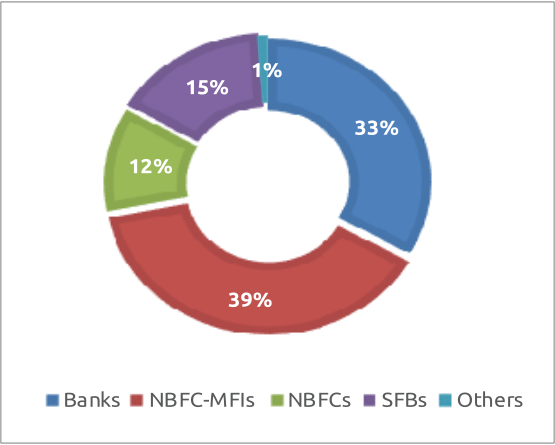
As of March 31, 2025, the total number of loan accounts serviced by all micro-lenders stood at 1,399 lakhs. The NBFC-MFIs maintained the largest market share with 539 lakh loan accounts, representing 39%, followed by Banks with 466 lakh loan accounts (33%). Small Finance Banks (SFBs) serviced 216 lakh loan accounts (15%), NBFCs accounted for 163 lakh loan accounts (12%), and Other lenders comprised 15 lakh loan accounts (1%). On a year-on-year basis, only the ‘Others’ category registered positive growth in loan accounts at 34%, whereas all other microlender categories experienced declines: NBFC-MFIs (-19%), SFBs (-12%), Banks (-11%), and NBFCs (-4%).
Figure 2.2: Y-o-Y Growth (in %) in Number of Loan Accounts across micro-lenders (in lakhs)
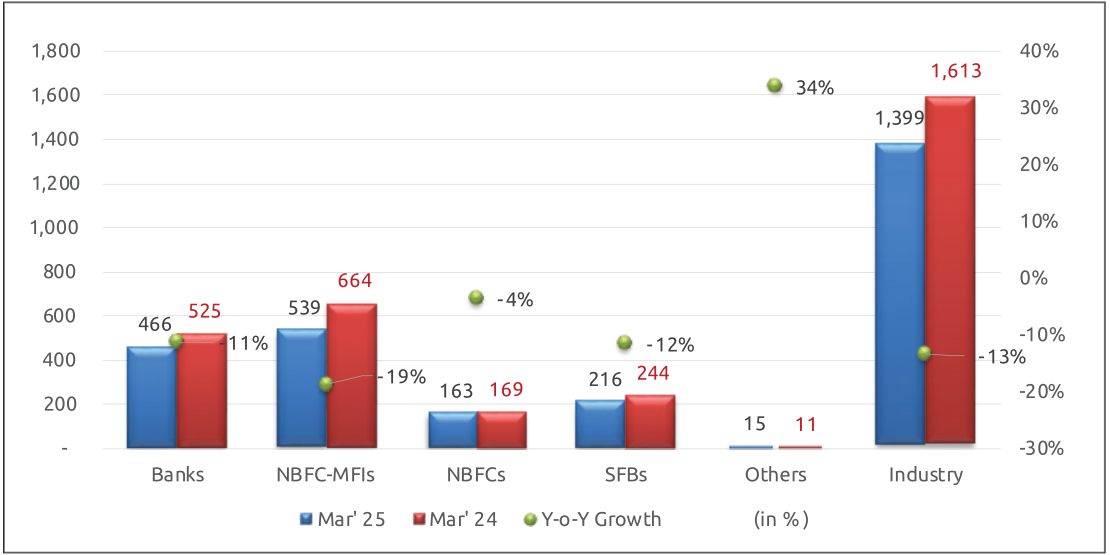
The contraction in loan accounts during FY 2024-25 reflected a deliberate recalibration by micro-lenders facing elevated credit risks within the microfinance industry. After an extended period of accelerated growth, rising delinquency rates signalled emerging vulnerabilities, prompting the micro lenders to shift towards more prudent, quality-centric lending practices. This transition resulted in both a reduction in the number of disbursed loans and a decrease in total outstanding loan balances, as lenders prioritized risk management and the long-term stability of their portfolios.
This change was also prompted by the guardrails issued by SROs like Sa-Dhan for reducing the overleverage and bringing the industry back to a better shape. As a result of this, there has been an improvement in terms of the number of micro-lenders for a borrower, which can be observed in Table 2.1.
Table 2.1 Distribution of Unique Active Borrowers across the number of micro-lenders as of March 2025 and March 2024
| Active Lender Associations | Unique Active Borrowers (in %) as on March 2025 | Unique Active Borrowers (in %) as on March 2024 |
|---|---|---|
| <=2 | 88.3% | 85.8% |
| 3 | 7.2% | 7.8% |
| 4 | 2.9% | 3.6% |
| >=5 | 1.6% | 2.8% |
2.2.2 State/UT-wise No. of Loan Accounts (in lakhs)
Table 2.2 depicts the loan accounts serviced across various States and Union Territories. A year-on-year analysis indicates that 32 States and UTs experienced a decline in the number of loan accounts. In contrast, four North Eastern states—Nagaland (29%), Arunachal Pradesh (17%), Meghalaya (5%), and Assam (1%)—registered an increase, although their overall share in the microfinance industry remains minimal. Notably, the principal states with the highest loan outstanding, including Tamil Nadu (-20%), Karnataka (-12%), Bihar (-9%), Uttar Pradesh (-8%), and West Bengal (-8%), saw a contraction in the number of loan accounts, reflecting broad-based negative growth in these key states.
Table 2.2 Loan Accounts (in lakhs) of all micro-lenders across States/UTs – March 2025 and March 2024 (in descending order of Loan Accounts)
| S. No. | State/UT | March 2025 (in lakhs) |
March 2024 (in lakhs) |
Y-o-Y Growth (in %) |
|---|---|---|---|---|
| 1 | Bihar | 202.32 | 221.75 | -9% |
| 2 | Tamil Nadu | 151.63 | 188.42 | -20% |
| 3 | Uttar Pradesh | 151.16 | 163.74 | -8% |
| 4 | Karnataka | 126.50 | 143.91 | -12% |
| 5 | West Bengal | 122.92 | 132.99 | -8% |
| 6 | Maharashtra | 111.30 | 124.70 | -11% |
| 7 | Odisha | 83.81 | 98.05 | -15% |
| 8 | Madhya Pradesh | 81.09 | 93.46 | -13% |
| 9 | Rajasthan | 56.33 | 67.83 | -17% |
| 10 | Andhra Pradesh | 50.01 | 68.65 | -27% |
| 11 | Jharkhand | 42.64 | 49.15 | -13% |
| 12 | Gujarat | 40.90 | 46.68 | -12% |
| 13 | Kerala | 40.47 | 48.83 | -17% |
| 14 | Telangana | 29.55 | 39.67 | -26% |
| 15 | Assam | 25.89 | 25.65 | 1% |
| 16 | Chhattisgarh | 24.43 | 28.16 | -13% |
| 17 | Haryana | 18.67 | 22.98 | -19% |
| 18 | Punjab | 17.44 | 23.89 | -27% |
| 19 | Tripura | 6.74 | 7.18 | -6% |
| 20 | Uttarakhand | 6.27 | 7.30 | -14% |
| 21 | Puducherry | 2.20 | 2.71 | -19% |
| 22 | Delhi | 2.15 | 2.67 | -20% |
| 23 | Goa | 0.60 | 0.67 | -12% |
| 24 | Himachal Pradesh | 0.56 | 0.64 | -12% |
| 25 | Meghalaya | 0.52 | 0.50 | -5% |
| 26 | Others | 0.52 | 0.71 | -28% |
| 27 | Mizoram | 0.43 | 0.43 | -1% |
| 28 | Sikkim | 0.40 | 0.42 | -6% |
| 29 | Manipur | 0.38 | 0.46 | -18% |
| 30 | Arunachal Pradesh | 0.35 | 0.30 | 17% |
| 31 | Jammu & Kashmir | 0.27 | 0.28 | -1% |
| 32 | Nagaland | 0.21 | 0.16 | 29% |
| 33 | Chandigarh | 0.18 | 0.21 | -16% |
| 34 | Andaman and Nicobar Islands | 0.05 | 0.05 | -1% |
| 35 | Dadra and Nagar Haveli | 0.04 | 0.05 | -13% |
| 36 | Daman and Diu | 0.02 | 0.03 | -11% |
| 37 | Lakshadweep | 0.00 | 0.00 | -25% |
| Industry | 1,399 | 1,613 | -13% |
Table 2.3 No. of Unique Active Borrowers, Loan Accounts, Share of Unique Accounts, and Loan Outstanding vs Active Lender Associations as of March 2025
| Active Lender Associations | No. of Unique Active Borrowers (in Lakhs) | Share of Unique Accounts (in %) | No. of Loan Accounts (in Lakhs) | Loan Outstanding (in ₹ Cr.) |
|---|---|---|---|---|
| <=2 | 731 | 88.3 | 1,014 | 2,78,787 |
| 3 | 59 | 7.2 | 199 | 56,069 |
| 4 | 24 | 2.9 | 107 | 27,742 |
| >=5 | 13 | 1.6 | 79 | 18,627 |
| Industry | 828 | 1,399 | 3,81,225 |
It can be observed from Table 2.3 above that the majority share of the unique active borrowers, industry loan outstanding, and loan accounts is concentrated within the bucket of less than 2 active micro-lenders. The guardrails introduced by the SROs, such as capping the number of micro-lenders at 3 micro-lenders, the total credit exposure of a borrower at ₹2 lakhs, among others, have reduced risk and contributed to more sustainable microfinance operations.