


Chapter 4 - Section 4.1 - SubSection 4.1.1Workforce in MLIs
In any financial institution, human resources form the backbone of operations, more so in microlending institutions (MLIs), which operate on a foot on street model. The frontline staff are crucial to MLIs in building client trust, ensuring repayment discipline, and supporting portfolio growth. The proper recruitment, training, and retention directly impact the efficiency and asset quality of the microfinance industry, making HR as vital as financial capital. However, while financial resources have received much attention, human resource development has often not been given due prominence. Many delinquency-related challenges stem from the staff practices shaped by their lack of understanding of the organizational mission, motivation, and client-centric approach. The challenge is further compounded as frontline staff, like their low-income clients, often have limited education and come from humble backgrounds and are lowly paid.

Market Share of Micro-Lenders in terms of Loans Accounts (in %)
Growth (in %) in Number of Loan Accounts across micro-lenders (in lakhs)
4.1.1 Workforce in MLIs
In any financial institution, human resources form the backbone of operations, more so in microlending institutions (MLIs), which operate on a foot on street model. The frontline staff are crucial to MLIs in building client trust, ensuring repayment discipline, and supporting portfolio growth. The proper recruitment, training, and retention directly impact the efficiency and asset quality of the microfinance industry, making HR as vital as financial capital. However, while financial resources have received much attention, human resource development has often not been given due prominence. Many delinquency-related challenges stem from the staff practices shaped by their lack of understanding of the organizational mission, motivation, and client-centric approach. The challenge is further compounded as frontline staff, like their low-income clients, often have limited education and come from humble backgrounds and are lowly paid.
The microfinance industry has recently been struggling to find committed and skilled employees in an adequate number. In recent years, HR challenges have aggravated due to changes in work culture across industries, changes in expectations of the workforce, increased work opportunities, especially in urban setups in the form of e-commerce and gig economy. Reports say around 12 million people work in gig economy, comprising over 2% of the total workforce. However, microfinance has some advantages over gig employment. In microfinance, employment is generally more stable and institutionalised, with regular salaries, social security benefits, and opportunities for skill development. It enables individuals to contribute to community development and financial inclusion, providing a sense of purpose and long-term impact. While the rural workforce encompasses agriculture, informal sectors, and microfinance, employment in microfinance is likely a minimal share compared to these other sectors.
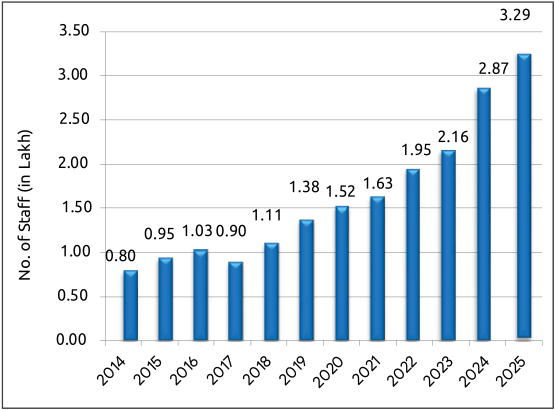
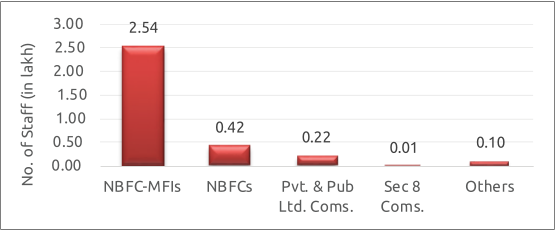
The microfinance employee base as of March 2025 is 3.29 lakhs, which is a 15% increase from the last year. The growth dropped to half from 33% during FY2023-24 to 15% in FY2024- 25. The total employee base of microfinance accounts for 0.06% of the total Workforce in India. The NBFC-MFI segment employs 77% of the total workforce, representing a 1% decrease from the last year.
1 https://www.livemint.com/money/personal-finance/indias-gig-economy-in-2025-growth-formalisation-and-financialinclusion-explained-11753438649777.html
2 Total labour force in India is 56.5 crores as per article: https://economictimes.indiatimes.com/budget-2024/economicsurvey-2024/economic-survey-2024-57-3-per-cent-of-the-total-workforce-self-employed-18-3-per-cent-working-as-unpaidworkers/articleshow/111920479.cms?from=mdr
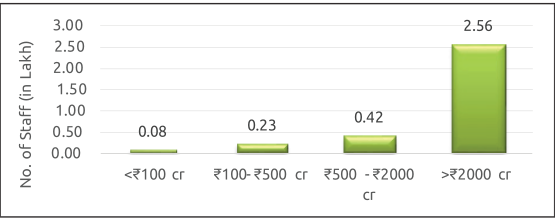
Figure 4.1.1: Number of MLI staff – Yearly trend and MLI-category-wise Break-up
The Loan officers, who form the base of the organisational hierarchy of a typical microfinance organisation, are instrumental in expanding the outreach of microfinance and building goodwill with microfinance clients. Microfinance has always been a hightouch activity, with personal contact playing a crucial role in delivering financial services to low-income clients. Human relationships and values such as trust and empathy are essential in determining the growth and sustainability of a Microfinance Institution. The MLIs’ frontline staff—the loan officers and other field staff—must uphold the values and maintain relationships with their clients, being the face for the MLIs to their borrowers. The Loan officers hold a critical position in influencing clients’ experiences with access to credit and their engagement with an MLI.
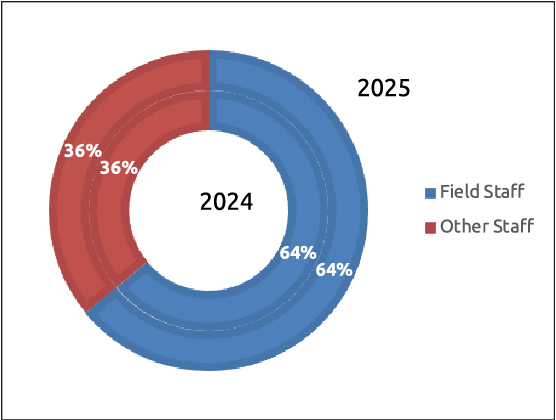
At the end of the last financial year, there were 2.09 lakhs field staff, which comprise 64% of the total staff. This ratio is unchanged from the last year. However, in terms of absolute numbers, the field staff has increased by 14%.
Figure 4.1.2: Distribution of staff in the last two years
Although microfinance borrowers are predominantly catering to women borrowers, the number being more than 95%, the share of women staff to the total staff in microfinance is very less. The primary reasons for the low share of women employees may be due to the rigours of microfinance operations, which include longer hours of operation, Societal restrictions on women’s mobility, concern for their safety, and lack of awareness regarding such work opportunities. Moreover, at the macro level, the participation rate of the female labour force in India at 35.6% is lower than that of men (77.5%) as per 2023-24 data3 . As of FY 2024-25, the microfinance industry employs a total of 30,725 female employees, of which 54% are field staff. However, this accounts for only 9% of the total employee base in the Microfinance Industry, which has been showing a steady declining trend from 2014 onwards, as can be seen from table 4.1.1.
Table 4.1.1: Year-wise staff strength in MLIs and share of women staff
| Year | Total Staff (in lakh) | Women Staff (in lakh) | % of Women Staff to Total Staff |
|---|---|---|---|
| 2014 | 0.80 | 0.15 | 19% |
| 2015 | 0.95 | 0.15 | 16% |
| 2016 | 1.03 | 0.16 | 15% |
| 2017 | 0.90 | 0.11 | 12% |
| 2018 | 1.11 | 0.13 | 12% |
| 2019 | 1.38 | 0.16 | 12% |
| 2020 | 1.52 | 0.17 | 11% |
| 2021 | 1.61 | 0.17 | 10% |
| 2022 | 1.95 | 0.25 | 13% |
| 2023 | 2.16 | 0.26 | 12% |
| 2024 | 2.87 | 0.31 | 11% |
| 2025 | 3.29 | 0.31 | 9% |
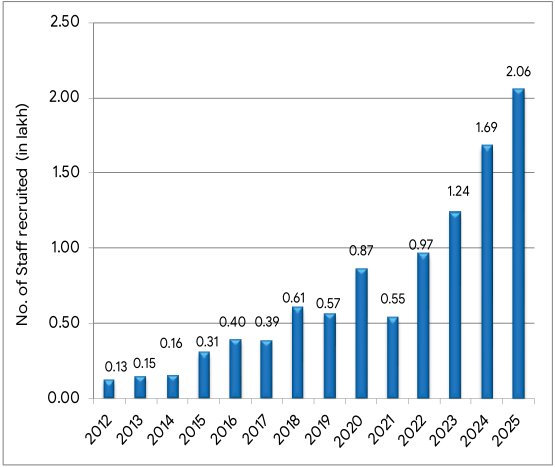
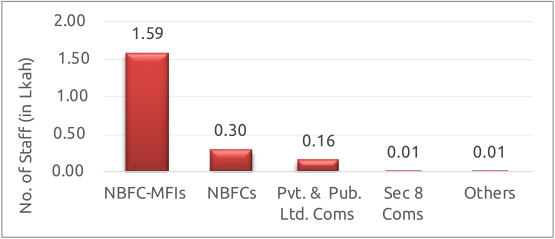
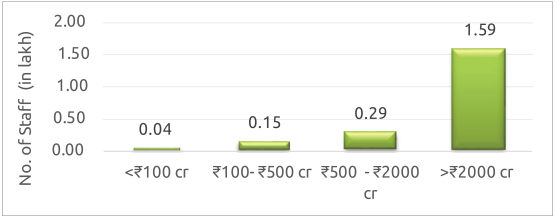
There are many challenges that an MLI faces in recruiting and retaining the right kind of human resources, such as finding qualified and motivated candidates, skilling them and managing their motivational level, which can withstand the competitive demands of other sectors. Over the last financial year, the sector recruited 2.06 lakh new staff, representing a 22% increase from the previous year. The NBFC-MFIs recruited 77% of the new staff, and 77% of these staff members were placed in the very large (portfolio above ₹2,000 cr).
Figure 4.1.3: New Staff Recruitment and their break-up based on Legal Form and Size
3 Periodic Labour Force Survey (PLFS) Annual Report [July 2023 – June 2024].
Attrition of staff has become a significant concern for the MLIs’ operations. This is more so in recent days, especially after Covid pandemic, the movement of staff has been seen much sharper. In some cases, attrition is so high that the entire frontline staff is replaced in one or two years. Attrition is most commonly observed among entry-level staff, typically within the first three months. SaDhan’s internal study on the reasons behind high attrition reveals some key reasons, such as high work pressure and long working hours, both of which are attributed to increased delinquency in the sector. These issues, combined with the new opportunities that have emerged over the last few years, such as the gig economy and a shift in work culture worldwide, have fuelled the increase in attrition for the sector. According to a recent report by The Economic Times, the banking sector has witnessed a 103% attrition rate, while the NBFC segment has posted a 77% attrition rate7 as of end of December 2024. During the financial year 2024-25, the sector observed an overall attrition rate of around 52%.
Table 4.1.2: Staff Attrition across different categories during FY 2024-25
| Categories of institutions based on legal status and size of business | No. of staff at the beginning of the year (i.e., April’24) | No. of staff who left/dropped during the year | No. of new Staff recruited during the year | No. of staff at the end of the year (i.e., March 25) |
|---|---|---|---|---|
| Staff Attrition across Legal Form of MLIs | ||||
| NBFC-MFIs | 2,22,186 | 1,27,326 | 1,58,827 | 2,53,687 |
| NBFCs | 27,303 | 14,499 | 29,580 | 42,384 |
| Pvt. & Pub Ltd. Coms | 21,734 | 16,572 | 16,341 | 21,503 |
| Sec. 8 Coms | 1,423 | 483 | 534 | 1,474 |
| Other NGO-MFIs | 10,546 | 918 | 793 | 10,421 |
| Total | 2,83,192 | 1,59,798 | 2,06,075 | 3,29,469 |
| Staff Attrition across Size of MLIs | ||||
| ≤100 Cr. | 7,311 | 3,011 | 4,068 | 8,368 |
| ₹100 Cr.–₹500 Cr. | 22,181 | 13,926 | 14,637 | 22,892 |
| ₹500 Cr.–₹2000 Cr. | 37,092 | 23,999 | 28,654 | 41,747 |
| ≥2000 Cr. | 2,16,608 | 1,18,862 | 1,58,716 | 2,56,462 |
| Total | 2,83,192 | 1,59,798 | 2,06,075 | 3,29,469 |
There is an employee bureau set up by Equifax India in 2017 for the microfinance industry, which is quite a unique initiative. This is part of Equifax’s India Workforce Solutions (IWS) offering, allows MFIs to access real-time, non-finance employment data to improve hiring quality and prevent fraudulent activities among their large, mobile, and primarily field-level workforce. Around 77% reported MLIs (100 out of 130) are participating in the bureau by sharing information and using it for background checks during staff onboarding.