


Chapter 2 - Section 2.3Loan Outstanding Analysis
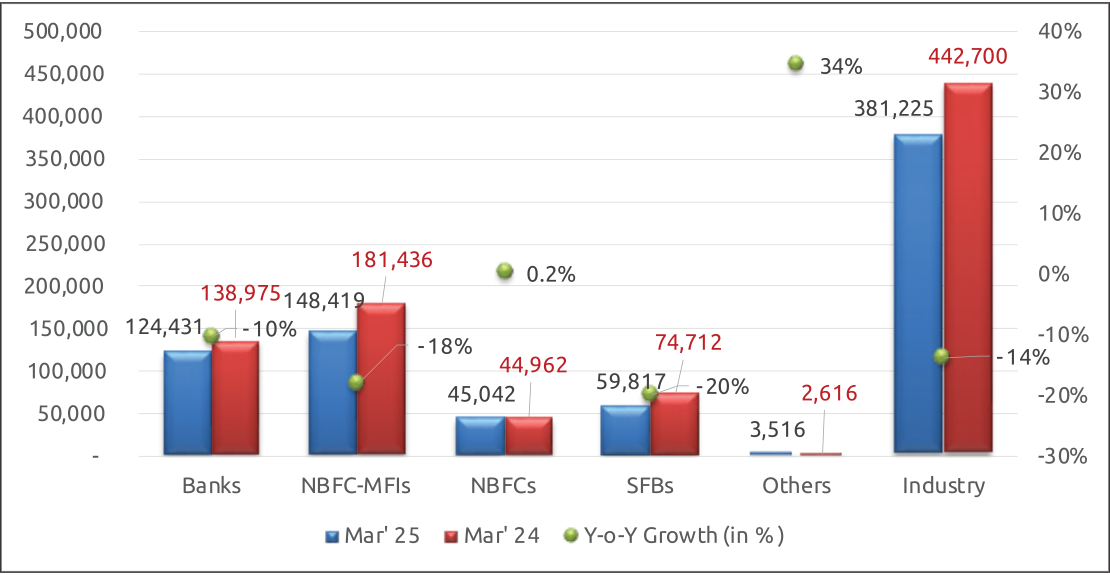
At the close of FY 2024-25, the total microcredit loan outstanding across all micro-lenders was ₹ 3,81,225 Cr., reflecting a year-on-year decline of 14%. Most of the micro-lenders reported negative growth during the reporting period, with the Small Finance Banks (SFBs) experiencing the steepest decline at 20%, followed by NBFC-MFIs at 18% and Banks at 10%. Conversely, non-NBFC-MFIs and NBFCs reported positive growth of 34% and 0.2%, respectively. The overall reduction in loan outstanding was driven not by a decrease in demand but by a deliberate attempt by the lenders due to significant repayment stress and a strategic shift toward cautious risk management. This included measures such as restrictions on multiple lending, enhanced credit assessments, and liquidity crunch during FY 2024-25.

Loan Outstanding (in ₹ Cr.) across micro-lenders
Market Share of micro-lenders in terms of Loan Outstanding (in %)
Regional distribution of loan outstanding (in %)
2.3 Loan Outstanding Analysis
2.3.1 Loan Outstanding (in ₹ Cr.)2
Figure 2.3: Loan Outstanding (in ₹ Cr.) across micro-lenders
2 Off-balance sheet (managed, assigned, and business correspondent) loan outstanding of NBFC-MFIs, NBFCs, and Non-Profit MFIs is included under the Bank’s category
At the close of FY 2024-25, the total microcredit loan outstanding across all micro-lenders was ₹3,81,225 Cr., reflecting a year-on-year decline of 14%. Most of the micro-lenders reported negative growth during the reporting period, with the Small Finance Banks (SFBs) experiencing the steepest decline at 20%, followed by NBFC-MFIs at 18% and Banks at 10%. Conversely, non-NBFC-MFIs and NBFCs reported positive growth of 34% and 0.2%, respectively. The overall reduction in loan outstanding was driven not by a decrease in demand but by a deliberate attempt by the lenders due to significant repayment stress and a strategic shift toward cautious risk management. This included measures such as restrictions on multiple lending, enhanced credit assessments, and liquidity crunch during FY 2024-25.
2.3.2 State/UT-wiseLoanOutstanding(in₹Cr.)
Table 2.4 outlines the loan outstanding across States and Union Territories. Year-on-year analysis reveals that 32 States/UTs experienced a decline in loan outstanding during the period. Only four states with relatively smaller microfinance footprints—Arunachal Pradesh (29%), Nagaland (24%), Telangana (14%), and Meghalaya (8%)—recorded positive growth.
In contrast, major states with significant loan outstanding, including Tamil Nadu (-20%), Karnataka (-17%), Bihar (-12%), Uttar Pradesh (-10%), and West Bengal (-9%), witnessed substantial declines. The widespread stress in the microfinance industry, primarily driven by credit overexposure and related recovery challenges, led to a reduction in fresh credit disbursements and, consequently, a decrease in loan outstanding
Furthermore, the state-level regulatory interventions— such as the Karnataka Micro Loan and Small Loan (Prevention of Coercive Actions) Bill, 2025, created some apprehension among the lenders regarding potential operational constraints and increased compliance requirements.
Table 2.4 Loan Outstanding (in ₹ Cr.) of all micro-lenders across States/UTs - March 2025 and March 2024 (in descending order of Loan Outstanding)
| S. No | State/UT | March 2025 (in ₹ Cr.) |
March 2024 (in ₹ Cr.) |
Y-o-Y Growth (in %) |
|---|---|---|---|---|
| 1 | Bihar | 57,712 | 65,487 | -12% |
| 2 | Tamil Nadu | 46,833 | 58,239 | -20% |
| 3 | Uttar Pradesh | 41,774 | 46,304 | -10% |
| 4 | West Bengal | 36,730 | 40,328 | -9% |
| 5 | Karnataka | 35,351 | 42,560 | -17% |
| 6 | Maharashtra | 29,596 | 33,304 | -11% |
| 7 | Madhya Pradesh | 21,653 | 24,870 | -13% |
| 8 | Odisha | 20,719 | 25,615 | -19% |
| 9 | Rajasthan | 14,930 | 18,144 | -18% |
| 10 | Kerala | 11,273 | 14,159 | -20% |
| 11 | Jharkhand | 11,149 | 13,118 | -15% |
| 12 | Gujarat | 10,913 | 13,107 | -17% |
| 13 | Andhra Pradesh | 7,322 | 8,346 | -12% |
| 14 | Assam | 7,082 | 7,410 | -4% |
| 15 | Chhattisgarh | 6,553 | 7,493 | -11% |
| 16 | Telangana | 5,717 | 5,015 | 14% |
| 17 | Haryana | 5,138 | 6,236 | -18% |
| 18 | Punjab | 4,372 | 5,684 | -23% |
| 19 | Tripura | 2,196 | 2,314 | -6% |
| 20 | Uttarakhand | 1,749 | 2,077 | -16% |
| 21 | Puducherry | 671 | 842 | -20% |
| 22 | Delhi | 616 | 795 | -23% |
| 23 | Himachal Pradesh | 160 | 182 | -12% |
| 24 | Goa | 155 | 195 | -21% |
| 25 | Meghalaya | 139 | 129 | 8% |
| 26 | Sikkim | 131 | 133 | -1% |
| 27 | Mizoram | 111 | 121 | -9% |
| 28 | Arunachal Pradesh | 105 | 81 | 29% |
| 29 | Others | 90 | 172 | -48% |
| 30 | Jammu & Kashmir | 80 | 83 | -4% |
| 31 | Manipur | 80 | 104 | -23% |
| 32 | Nagaland | 68 | 55 | 24% |
| 33 | Chandigarh | 46 | 54 | -15% |
| 34 | Andaman and Nicobar Islands | 18 | 20 | -9% |
| 35 | Dadra and Nagar Haveli | 14 | 16 | -12% |
| 36 | Daman and Diu | 7 | 9 | -20% |
| 37 | Lakshadweep | 0.02 | 0.03 | -39% |
| Industry | 3,81,225 | 4,42,700 | -14% |
Figure 2.4: Market Share of micro-lenders in terms of Loan Outstanding (in %)
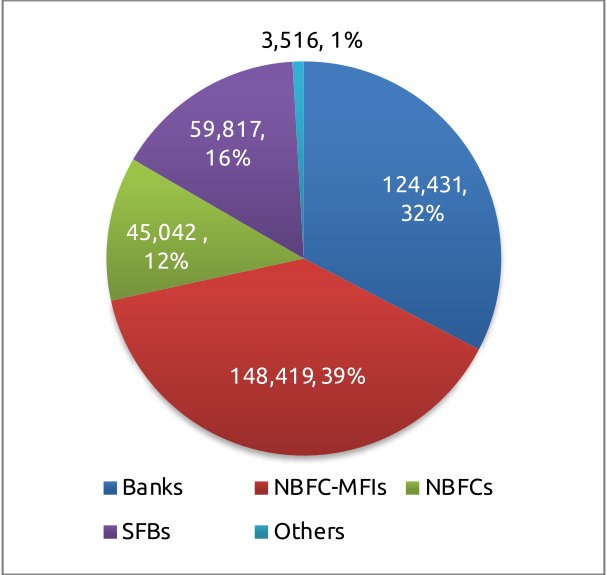
In terms of market share of loan outstanding, NBFC-MFIs remained the dominant providers of microcredit, accounting for 39% of the total market. Banks held the second-largest share at 32%, followed by Small Finance Banks (SFBs) with 16%, NBFCs with 12%, and Others comprising the remaining 1%.
2.3.3 State/UT-wise Loan Outstanding per Unique Active Borrowers (in ₹)
Table 2.5 provides data on loan outstanding per unique active borrowers across States and Union Territories, showing an overall year-on-year decrease of 10%. This decline is largely attributable to a more cautious and risklimiting stance adopted by micro-lenders in response to rising delinquencies and increased borrower leverage. Additional contributing factors include regulatory measures imposed by self-regulatory organizations, such as restrictions on the number of micro-lenders and caps on combined microfinance and retail (unsecured) loan exposure for households, which is not to exceed ₹2 lakhs.
Table 2.5 Loan Outstanding per Unique Active Borrowers across States/UTs (in ₹) - March 2025 and March 2024 (in descending order of Loan Outstanding per Unique Active Borrowers)
| S. No | State/UT | March 2025 (in ₹) |
March 2024 (in ₹) |
Y-o-Y Growth (in %) |
|---|---|---|---|---|
| 1 | Karnataka | 56,362 | 64,925 | -13% |
| 2 | Puducherry | 55,327 | 65,511 | -16% |
| 3 | Tamil Nadu | 54,776 | 62,807 | -13% |
| 4 | Bihar | 51,136 | 59,885 | -15% |
| 5 | Kerala | 50,968 | 63,826 | -20% |
| 6 | West Bengal | 47,973 | 52,251 | -8% |
| 7 | Goa | 47,633 | 54,891 | -13% |
| 8 | Tripura | 47,511 | 50,321 | -6% |
| 9 | Maharashtra | 47,091 | 50,897 | -7% |
| 10 | Jharkhand | 46,446 | 53,636 | -13% |
| 11 | Arunachal Pradesh | 45,962 | 41,109 | 12% |
| 12 | Odisha | 45,956 | 55,495 | -17% |
| 13 | Dadra and Nagar Haveli | 45,316 | 78,249 | -42% |
| 14 | Uttar Pradesh | 44,949 | 50,674 | -11% |
| 15 | Jammu & Kashmir | 43,378 | 45,016 | -4% |
| 16 | Daman and Diu | 43,199 | 1,25,812 | -66% |
| 17 | Uttarakhand | 42,798 | 48,560 | -12% |
| 18 | Chhattisgarh | 42,695 | 45,277 | -6% |
| 19 | Haryana | 42,375 | 47,611 | -11% |
| 20 | Madhya Pradesh | 42,239 | 46,344 | -9% |
| 21 | Nagaland | 42,152 | 39,504 | 7% |
| 22 | Rajasthan | 41,364 | 47,192 | -12% |
| 23 | Gujarat | 40,747 | 47,948 | -15% |
| 24 | Sikkim | 40,624 | 41,890 | -3% |
| 25 | Himachal Pradesh | 39,867 | 43,301 | -8% |
| 26 | Andaman and Nicobar Islands | 39,006 | 41,657 | -6% |
| 27 | Punjab | 38,568 | 42,901 | -10% |
| 28 | Chandigarh | 36,618 | 39,493 | -7% |
| 29 | Delhi | 35,139 | 39,346 | -11% |
| 30 | Assam | 33,844 | 37,602 | -10% |
| 31 | Lakshadweep | 32,741 | 53,477 | -39% |
| 32 | Meghalaya | 31,852 | 31,454 | 1% |
| 33 | Mizoram | 30,455 | 32,032 | -5% |
| 34 | Telangana | 27,165 | 17,378 | 56% |
| 35 | Manipur | 22,988 | 24,798 | -7% |
| 36 | Andhra Pradesh | 22,176 | 18,002 | 23% |
| 37 | Others | 21,303 | 35,207 | -39% |
| Industry | 46,064 | 51,051 | -10% | |
On a year-on-year comparison, 31 States and Union Territories recorded a decline in loan outstanding per borrower, with the exception of five states with relatively limited microfinance market presence i.e., Telangana (56%), Andhra Pradesh (23%), Arunachal Pradesh (12%), Nagaland (7%), and Meghalaya (1%)—which experienced increases. In contrast, key states with substantial loan outstanding, such as Bihar (-15%), Tamil Nadu and Karnataka (-13% each), Uttar Pradesh (-11%), and West Bengal (-8%), witnessed notable declines in loan outstanding per borrower
Table 2.6 Distribution of industry loan outstanding (in ₹ Cr.) across active lenders and borrowers’ credit exposure as of March 2025
The following table depicts the distribution of loan outstanding (in ₹ Cr.) across different numbers of active lenders and borrowers’ credit exposure:
| Active Lenders/ Borrower Credit Exposure | < ₹1 Lakh | ₹1 Lakh–₹1.25 Lakh | ₹1.25 Lakh–₹1.5 Lakh | ₹1.5 Lakh+ |
|---|---|---|---|---|
| < 2 lenders | 2,31,500 | 26,083 | 12,065 | 9,139 |
| 3 lenders | 21,399 | 13,233 | 10,134 | 11,303 |
| 4 lenders | 6,136 | 6,041 | 6,095 | 9,470 |
| 5 lenders | 1,807 | 2,639 | 3,463 | 10,718 |
It can be observed from Table 2.6 above that the majority of the industry loan outstanding, i.e., 61% is concentrated within the bucket of less than 2 active micro-lenders and having a credit exposure of less than ₹1 lakh. The guardrails introduced by the SROs, such as capping the number of micro-lenders at 3 micro-lenders, the total credit exposure of a borrower at ₹2 lakhs, among others, and complemented by the RBI regulations, forms part of a broader framework aimed at ensuring responsible lending, strengthening borrower protection etc. which have limited the borrowers’ credit exposure, thereby reducing risk and contributing to more sustainable microfinance operations.
Figure 2.5: Regional distribution of Loan Outstanding (in %)
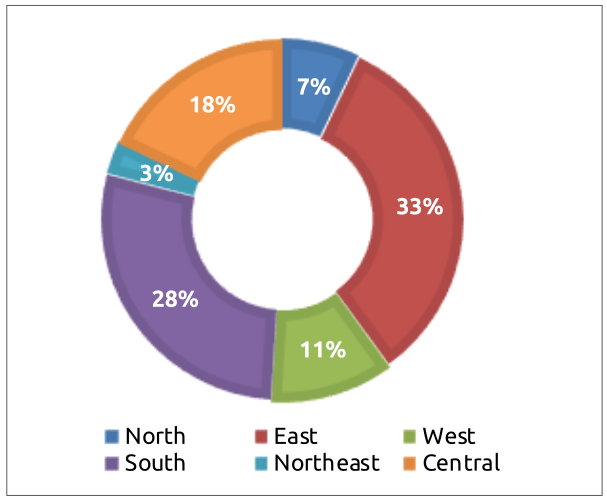
In terms of regional distribution of loan outstanding, the Eastern region—comprising Bihar, Odisha, Jharkhand, West Bengal, and Andaman & Nicobar Islands—led with a 33% market share. This was followed by the Southern region, which includes Andhra Pradesh, Karnataka, Kerala, Tamil Nadu, Telangana, Puducherry, and Lakshadweep, accounting for 28%. The Central region, consisting of Madhya Pradesh, Uttar Pradesh, Chhattisgarh, and Uttarakhand, held 18% of the market share. The Western region, covering Gujarat, Maharashtra, Goa, and Dadra & Nagar Haveli and Daman & Diu, contributed 11%, while the Northern region— encompassing Delhi, Haryana, Rajasthan, Punjab, Chandigarh, Himachal Pradesh, Jammu & Kashmir, and Ladakh—accounted for 7%. The Northeastern states, including Assam, Manipur, Tripura, Nagaland, Sikkim, Meghalaya, Mizoram, and Arunachal Pradesh, had the smallest share at 3%.
2.3.4 State/UT-wise Average Balance per Loan Account (in ₹)
The State and Union Territory-wise average balance per loan account is detailed in Table 2.7. As of March 31, 2025, the overall average balance per loan account in the microfinance industry stood at ₹27,251, reflecting a year-on-year decline of 1% from ₹27,441 recorded on March 31, 2024.
On a Y-o-Y comparison, 25 States and UTs experienced a decrease in average balance per loan account. Notable declines were observed in key states with significant loan outstanding, including Karnataka (-6%), Bihar (-3%), Uttar Pradesh (-2%), West Bengal (-1%), and Tamil Nadu (-0.1%).
Table 2.7: Average Balance per Loan Account (in ₹) - March 2025 and March 2024 (in descending order of Average Balance per Loan Account)
| S. No | State/UT | March 2025 (in ₹) |
March 2024 (in ₹) |
Y-o-Y Growth (in %) |
|---|---|---|---|---|
| 1 | Andaman and Nicobar Islands | 34,230 | 36,859 | -7% |
| 2 | Dadra and Nagar Haveli | 34,177 | 33,884 | 1% |
| 3 | Nagaland | 33,213 | 34,081 | -3% |
| 4 | Sikkim | 33,173 | 31,711 | 5% |
| 5 | Tripura | 32,171 | 32,227 | 0% |
| 6 | Tamil Nadu | 30,886 | 30,909 | 0% |
| 7 | Puducherry | 30,452 | 31,006 | -2% |
| 8 | Arunachal Pradesh | 30,257 | 27,420 | 10% |
| 9 | West Bengal | 29,880 | 30,324 | -1% |
| 10 | Jammu & Kashmir | 29,298 | 30,143 | -3% |
| 11 | Delhi | 28,653 | 29,738 | -4% |
| 12 | Daman & Diu | 28,632 | 32,106 | -11% |
| 13 | Bihar | 28,525 | 29,532 | -3% |
| 14 | Himachal Pradesh | 28,425 | 28,487 | 0% |
| 15 | Karnataka | 27,946 | 29,574 | -6% |
| 16 | Uttarakhand | 27,885 | 28,441 | -2% |
| 17 | Kerala | 27,855 | 28,995 | -4% |
| 18 | Uttar Pradesh | 27,636 | 28,279 | -2% |
| 19 | Haryana | 27,517 | 27,144 | 1% |
| 20 | Assam | 27,359 | 28,892 | -5% |
| 21 | Chhattisgarh | 26,823 | 26,238 | 2% |
| 22 | Madhya Pradesh | 26,702 | 26,610 | 0% |
| 23 | Meghalaya | 26,702 | 25,998 | 3% |
| 24 | Gujarat | 26,679 | 28,077 | -5% |
| 25 | Maharashtra | 26,592 | 26,708 | 0% |
| 26 | Rajasthan | 26,505 | 26,751 | -1% |
| 27 | Jharkhand | 26,145 | 26,689 | -2% |
| 28 | Mizoram | 26,053 | 26,189 | -8% |
| 29 | Chandigarh | 25,944 | 25,524 | 2% |
| 30 | Goa | 25,912 | 28,939 | -10% |
| 31 | Punjab | 25,071 | 23,796 | 5% |
| 32 | Odisha | 24,720 | 26,123 | -5% |
| 33 | Lakshadweep | 21,827 | 26,738 | -18% |
| 34 | Manipur | 21,194 | 22,540 | -6% |
| 35 | Telangana | 19,348 | 12,643 | 53% |
| 36 | Others | 17,445 | 24,192 | -28% |
| 37 | Andhra Pradesh | 14,642 | 12,157 | 20% |
| Industry | 27,251 | 27,441 | -1% |
2.3.5 Top States and Districts in terms of Loan Outstanding:
The top 10 States and top 25 districts in terms of total loan outstanding at the end of the FY 2024-25 are given in Table 2.8 and Table 2.9, respectively. Bihar continues to be the top state in terms of loan outstanding, and the top 5 states continue to be the same for the last two years.
Table 2.8: Top 10 States in terms of Loan Outstanding (in ₹ Cr.)
| Microfinance Industry – all micro-lenders | |
|---|---|
| State | Loan Outstanding (in ₹ Cr.) |
| Bihar | 57,712 |
| Tamil Nadu | 46,833 |
| Uttar Pradesh | 41,774 |
| West Bengal | 36,730 |
| Karnataka | 35,351 |
| Maharashtra | 29,596 |
| Madhya Pradesh | 21,653 |
| Odisha | 20,719 |
| Rajasthan | 14,930 |
| Kerala | 11,273 |
The top 10 states accounted for 83% of the share in the industry loan outstanding, while the top 5 states alone accounted for 57% of the industry loan outstanding.
Similarly, the loan outstanding of the top 25 districts in the country is mapped and given below. This data is the cumulative outstanding of various micro lenders as of 31 March 2025 in these 25 districts.
Table 2.9 Top 25 Districts in terms of Loan Outstanding (in ₹ Cr.)
| Microfinance Industry – all micro-lenders | ||
|---|---|---|
| State | District | Loan Outstanding (in ₹ Cr.) |
| West Bengal | Murshidabad | 4,239 |
| Bihar | East Champaran | 3,855 |
| Bihar | Muzaffarpur | 3,681 |
| Bihar | Samastipur | 3,655 |
| West Bengal | North 24 Parganas | 3,154 |
| Karnataka | Mysuru | 3,081 |
| Bihar | Madubani | 3,036 |
| Karnataka | Belagavi | 2,867 |
| Bihar | Darbhanga | 2,715 |
| Tamil Nadu | Cuddalore | 2,703 |
| West Bengal | South 24 Parganas | 2,657 |
| Bihar | West Champaran | 2,597 |
| Bihar | Aurangabad | 2,396 |
| Tamil Nadu | Thanjavur | 2,365 |
| Bihar | Purnia | 2,317 |
| Bihar | Sitamarhi | 2,315 |
| Bihar | Begusarai | 2,279 |
| Karnataka | Tumkur | 2,242 |
| Bihar | Vaishali | 2,242 |
| West Bengal | Nadia | 2,215 |
| Tamil Nadu | Salem | 2,201 |
| Uttar Pradesh | Gorakhpur | 2,156 |
| West Bengal | Howrah | 2,133 |
| West Bengal | Hooghly | 2,101 |
| Maharashtra | Nagpur | 2,091 |
The top 25 districts by loan outstanding included 11 districts from Bihar, 6 from West Bengal, 3 from Tamil Nadu, 3 from Karnataka, and one each from Maharashtra and Uttar Pradesh. All these districts had loan outstanding exceeding ₹2,000 Cr., with 7 districts surpassing ₹3,000 Cr. Murshidabad district in West Bengal recorded the highest loan outstanding, exceeding ₹4,000 Cr. The combined loan outstanding of the top 25 districts accounted for 18% of the industry loan outstanding, while the top 10 districts alone contributed 9%. A notable decline was observed in the number of districts with loan outstanding greater than ₹2,000 Cr., falling from 41 as of March 31, 2024, to 29 as of March 31, 2025.